Best Ecommerce Hosting Plans (2026): Compared by Price and Features
[Updated: March 23, 2026] Choosing the wrong ecommerce hosting plan costs more than money. Slow pages lose customers, weak security risks breaches, and cheap plans need replacing within months.
This guide compares 10 hosting providers with verified 2026 prices and explains what Magento stores need.
Key Takeaways
-
Ecommerce hosting plans provide the server infrastructure online stores need to process orders, manage catalogs, and protect customer data.
-
Five hosting types serve different business stages: shared ($2 to $15/month), VPS ($20 to $100/month), dedicated ($100 to $300/month), cloud ($50 to $500/month), and managed ($149 to $1,499+/month).
-
Speed, security, scalability, PCI compliance, and support are the five factors that determine whether a hosting plan fits your store.
-
Magento stores have specific requirements other platforms do not: PHP 8.3+, MySQL 8.4, OpenSearch, Varnish cache, and Redis for session storage.
-
The cheapest plan often costs more long term. Intro prices double or triple on renewal, and hidden fees add up.
-
MGT Commerce provides managed Magento hosting on AWS starting at EUR 149/month with Varnish, Redis, CDN, and 24/7 support included.
What Are Ecommerce Hosting Plans?
Ecommerce hosting plans = web hosting services built for online stores. They include SSL certificates, payment gateway support, PCI compliance, and server resources optimized for catalog management and checkout processing.
Perfect for: Online store owners, Magento merchants, WooCommerce shops, any business selling products or services online.
Not ideal for: Static websites, personal blogs, or portfolios with no transaction processing needs.
Standard web hosting serves static pages. Ecommerce hosting handles dynamic product pages, shopping cart sessions, payment processing, and customer account management. These tasks demand more CPU, RAM, and database performance than a blog or brochure site.
The right ecommerce hosting plan keeps your store fast under traffic spikes, protects customer payment data, and scales with your business. The wrong plan creates slow checkout pages, security gaps, and forced migrations when you outgrow it.
Global retail ecommerce reached $6.42 trillion in 2025 and is projected to hit $6.88 trillion in 2026 (eMarketer, 2025). As more transactions move online, hosting infrastructure becomes the foundation that determines whether a store captures or loses that revenue.
5 Types of Ecommerce Hosting Plans
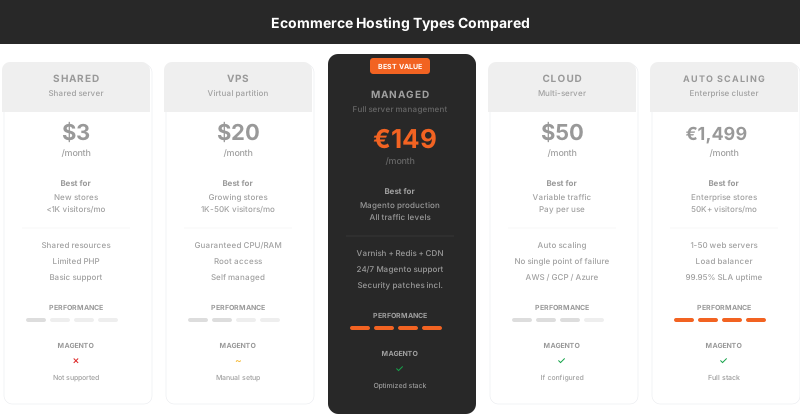
1. Shared Hosting places multiple websites on one server. Resources are split between tenants. Good for new stores testing the market with under 1,000 visitors per month. Expect $2 to $15/month. The tradeoff: one busy neighbor site slows everyone down. Most shared plans lack the PHP versions and caching layers Magento requires.
2. VPS Hosting gives your store a virtual partition with guaranteed CPU and RAM. Medium traffic stores (1,000 to 50,000 visitors/month) benefit from the isolation without dedicated server costs. Plans range from $20 to $100/month. You get root access and can install the software stack your platform needs.
3. Dedicated Hosting reserves an entire physical server for your store. Full control over configuration, maximum performance, and no shared resources. Large stores with 50,000+ monthly visitors and resource intensive catalogs need this level. Expect $100 to $300/month. Best for stores with predictable, high traffic patterns.
4. Cloud Hosting distributes your store across multiple servers. When traffic spikes during sales or holidays, cloud hosting adds resources on demand. No single point of failure means better uptime. Plans range from $50 to $500/month based on usage. AWS, Google Cloud, and Azure are the main infrastructure providers.
5. Managed Magento Hosting combines cloud or dedicated infrastructure with full server management. Your hosting provider handles security patches, performance tuning, backups, and monitoring. Read our managed hosting guide for a deep dive on when this makes sense. Plans start at EUR 149/month for Magento specific setups. This option saves 10 to 20 hours per month in server administration.
7 Features to Look for in Ecommerce Hosting
1. Fast Page Load Times
Every second of load time costs conversions. Sites loading in 1 second convert 2.5x better than those loading in 5 seconds (Portent, 2022). Look for hosts with SSD storage, HTTP/2, and server side caching. For Magento stores, Varnish full page cache and Redis session storage are essential. Check our speed optimization guide for benchmarks.
2. Adequate Bandwidth and Storage
Product images, customer uploads, and traffic volume determine your bandwidth needs. A store with 10,000 SKUs and high resolution images needs more than 50GB of storage. Avoid hosts that throttle bandwidth during peak traffic. Look for unmetered bandwidth or clear overage policies.
3. Scalability
Black Friday traffic can hit 10x your daily average. Your hosting must add CPU and RAM without manual intervention or downtime. Cluster hosting and auto scaling configurations handle these spikes. Shared hosting cannot scale. The difference between a successful flash sale and a crashed site comes down to whether your hosting can handle the surge.
4. 24/7 Technical Support
Server issues happen outside business hours. Pick a host with round the clock support from engineers who know your platform. Generic support teams reading scripts waste your time during outages. Magento specific support resolves issues faster because the team knows the stack.
5. Full Security Stack
Online stores handle credit card data. That requires PCI compliance, SSL/TLS certificates, a Web Application Firewall (WAF), DDoS protection, and malware scanning. Security breaches cost an average of $4.88 million per incident (IBM Cost of a Data Breach Report, 2024). Prevention costs a fraction of that.
6. Automatic Backups
Daily automated backups with off site storage protect against data loss. Look for hosts that offer point in time recovery, not just daily snapshots. Hourly backups matter for high transaction stores where losing even one hour of orders creates real revenue impact.
7. Developer Tools
SSH access, Git integration, staging environments, and CLI tools let your development team deploy updates without downtime. Hosts that restrict terminal access or force GUI only management slow down professional development workflows. A test environment lets you validate changes before they reach your live store.
Best Ecommerce Hosting Plans: Price Comparison (2026)
| Provider | Starting Price | Renewal Price | Best For | Magento Support |
|---|---|---|---|---|
| MGT Commerce | EUR 149/month | EUR 149/month (no markup) | Magento stores needing managed AWS hosting | Full |
| Cloudways | $11/month | $11/month | Budget managed cloud hosting | Yes |
| Nexcess | $37/month | $67/month | Magento and WooCommerce managed hosting | Full |
| SiteGround | $2.99/month | $15.99/month | Small WooCommerce stores | No |
| Bluehost | $3.99/month | $9.99/month | WordPress/WooCommerce beginners | No |
| Hostinger | $1.99/month | $10.99/month | Budget shared hosting | Limited |
| A2 Hosting | $2.99/month | $10.99/month | Speed focused shared hosting | Limited |
| Kinsta | $35/month | $35/month | Premium WordPress hosting | No |
| WP Engine | $20/month | $25/month | Enterprise WordPress sites | No |
| DigitalOcean | $4/month | $4/month | Self managed cloud infrastructure | DIY only |
Prices verified March 2026. Intro prices require 12 to 36 month commitments. Renewal prices apply after the initial term.
Important: SiteGround, Bluehost, Hostinger, Kinsta, and WP Engine do not support Magento. If you run a Magento store, your realistic options are MGT Commerce, Cloudways, Nexcess, or self managed infrastructure on DigitalOcean/AWS.
MGT Commerce Plans for Magento Stores
Single Server Plans
| Plan | Monthly Price | Domains | Support Requests | Response Time |
|---|---|---|---|---|
| Small Enterprise | EUR 149 | 1 | 3/month | 4 hours |
| Middle Business | EUR 199 | 2 | 5/month | 4 hours |
| Performance Enthusiast | EUR 249 | 5 | Unlimited | 2 hours |
All single server plans include free SSL/TLS, test environment, Redis cache, and Varnish cache. See the full single server vs auto scaling comparison for details on when to upgrade.
Multi Server Plans
| Plan | Monthly Price | Web Servers | Database | Test Server |
|---|---|---|---|---|
| Basic | EUR 299 | 1 | 1 RDS | No |
| Premium | EUR 499 | 1 | 1 RDS | Yes |
| Ultimate | EUR 999 | 2 to 4 | Master + Slave | Yes |
Auto Scaling Plans
| Plan | Monthly Price | Web Servers | Load Balancer | Test Servers |
|---|---|---|---|---|
| Basic | EUR 1,499 | 1 to 4 | Yes | 1 |
| Premium | EUR 1,999 | 1 to 10 | Yes | 2 |
| Enterprise | EUR 4,999 | 1 to 50 | Yes | 3 |
All plans include MGT Add Ons, architecture diagram, and 24/7 support. AWS infrastructure fees are separate and depend on resource usage.
Cancellation and Billing
30 day cancellation policy with full refund. No lock in contracts. AWS charges are billed separate from MGT Commerce management fees.
What Magento Stores Need From Their Hosting
Magento has stricter server requirements than WooCommerce or Shopify. Running Magento on generic shared hosting creates performance problems within weeks. Here is what Magento 2.4.8 (current stable, March 2026) requires:
| Component | Required Version |
|---|---|
| PHP | 8.3 or 8.4 |
| MySQL | 8.4 |
| MariaDB | 11.4 |
| OpenSearch | 2.x |
| Elasticsearch | 8.17 |
| Redis/Valkey | 7.2 (Redis) or 8 (Valkey) |
| Composer | 2.9.3+ |
| Varnish | 7.6 |
| nginx | 1.26 |
Source: Adobe Experience League, verified March 2026
Most budget hosting providers do not support these requirements. Shared hosting plans run outdated PHP versions and lack OpenSearch, Varnish, or Redis. This forces workarounds that degrade store performance and create security gaps.
Over 111,000 live stores run on Magento as of March 2026 (StoreLeads). Each of these stores needs hosting that meets the specifications above. Generic hosting plans built for WordPress or static sites cannot deliver what Magento demands.
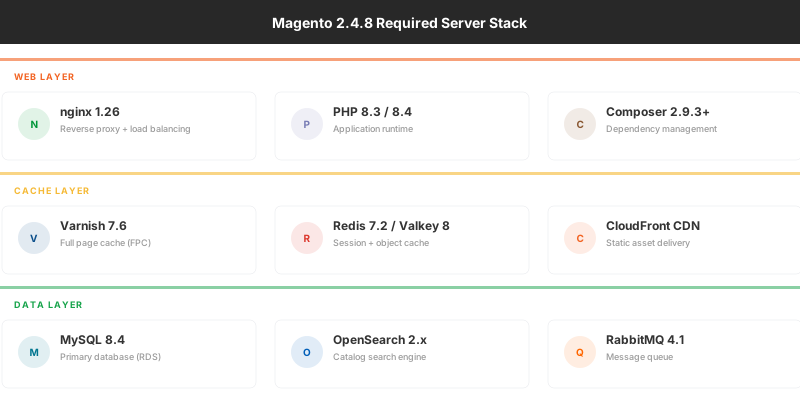
MGT Commerce builds every server stack to match these exact specifications. The Magento 2 technology stack includes:
Global Content Delivery
Fast page loads for international customers require servers close to your buyers. A Content Delivery Network caches your store's static assets (images, CSS, JavaScript) across global edge locations. This reduces latency for customers in Europe, Asia, and the Americas.
How Hosting Affects Your Store's Google Rankings
Google uses Core Web Vitals as a ranking factor. Three metrics determine your score:
| Metric | Target | What It Measures |
|---|---|---|
| LCP (Largest Contentful Paint) | Under 2.5s | How fast the main content loads |
| FID (First Input Delay) | Under 100ms | How fast the page responds to clicks |
| CLS (Cumulative Layout Shift) | Under 0.1 | How stable the layout is during load |
Your hosting controls LCP and FID. A slow server increases Time to First Byte (TTFB), which delays every subsequent metric. Stores on shared hosting with 800ms+ TTFB cannot achieve good Core Web Vitals scores regardless of frontend optimization.
Managed hosting with Varnish cache delivers TTFB under 200ms for cached pages. That gives your store a measurable ranking advantage over competitors on slower infrastructure.
The Real Cost of Ecommerce Hosting
The advertised price is not the real price. Budget hosts use intro pricing as a hook. Here is what year one vs year two looks like:
| Provider | Year 1 Cost | Year 2 Cost | Price Increase |
|---|---|---|---|
| SiteGround | $36/year | $192/year | +433% |
| Bluehost | $48/year | $120/year | +150% |
| Hostinger | $24/year | $132/year | +450% |
| A2 Hosting | $36/year | $132/year | +267% |
| MGT Commerce | EUR 1,788/year | EUR 1,788/year | 0% |
| Cloudways | $132/year | $132/year | 0% |
| Kinsta | $420/year | $420/year | 0% |
Managed hosting providers like MGT Commerce, Cloudways, and Kinsta charge the same rate from day one. No intro pricing traps.
Beyond the hosting fee, factor in these hidden costs:
- Migration costs: Moving from a cheap host to a better one costs $500 to $2,000 in developer time. Stores that start cheap almost always migrate within 12 months.
- Downtime losses: One hour of downtime during peak sales costs $1,000 to $100,000+ depending on store size. Budget hosts offer 99.5% uptime (43 hours of downtime per year). Managed hosts guarantee 99.95% (4.4 hours per year).
- Security breach costs: Average data breach cost is $4.88 million (IBM Cost of a Data Breach Report, 2024). PCI compliant managed hosting prevents most common attack vectors.
- Performance losses: Sites loading in 1 second convert 2.5x better than those loading in 5 seconds (Portent, 2022). For a store doing $50,000/month in sales, even a 1 second delay can cost thousands per month in lost conversions.
Pros and Cons of Ecommerce Hosting
FAQ
1. What is ecommerce hosting?
Ecommerce hosting provides server infrastructure designed for online stores. It includes SSL encryption, payment gateway support, higher resource allocations, and security features that standard web hosting lacks.
2. How much does ecommerce hosting cost?
Shared ecommerce hosting starts at $2 to $15/month. VPS hosting costs $20 to $100/month. Managed Magento hosting starts at EUR 149/month. Enterprise auto scaling setups range from EUR 1,499 to EUR 4,999/month. Budget plans often double or triple in price on renewal.
3. Can I run Magento on shared hosting?
Magento requires PHP 8.3+, MySQL 8.4, OpenSearch, Varnish, and Redis. Most shared hosting providers do not support these components. Running Magento on shared hosting results in slow page loads, timeout errors, and security vulnerabilities. Use VPS or managed hosting for production Magento stores.
4. What is the difference between managed and unmanaged hosting?
Managed hosting includes server setup, security patching, performance tuning, monitoring, and technical support. Unmanaged hosting gives you a bare server and you handle everything. Managed hosting costs more but saves 10 to 20 hours per month in server administration time.
5. How does hosting affect ecommerce SEO?
Server speed determines Time to First Byte (TTFB), which impacts Core Web Vitals. Google uses these metrics as ranking signals. Stores on fast hosting with sub 200ms TTFB rank better than stores on slow servers with 800ms+ TTFB.
6. Which hosting type is best for a new online store?
Start with VPS or cloud hosting if you plan to grow. Shared hosting saves money short term but forces a migration within 6 to 12 months as traffic grows. The migration costs more than the initial savings from choosing the cheap option.
7. Do I need PCI compliant hosting?
Yes, if your store processes credit card payments. PCI DSS compliance protects cardholder data. Non compliance exposes your business to fines of $5,000 to $100,000 per month and potential lawsuits after a data breach.
8. What is auto scaling hosting?
Auto scaling adds server resources when traffic increases and removes them when traffic drops. You pay for what you use. This prevents site crashes during sales events and avoids paying for idle server capacity during quiet periods.
Summary
Ecommerce hosting determines your store's speed, security, and growth potential. The right plan matches your platform requirements, traffic volume, and budget.
For Magento stores, managed hosting on AWS provides the specific stack (PHP 8.3+, Varnish, Redis, OpenSearch) that Magento demands. Budget shared hosting cannot deliver this.
Explore MGT Commerce hosting plans to find the right setup for your Magento store.