Google's Universal Commerce Protocol: What You as a Magento Store Owner Need to Know
The way we shop online is about to change at its core. Here's what Google's new open standard means for your Magento store.
Key Takeaways
- Google's Universal Commerce Protocol (UCP) lets AI agents complete purchases on behalf of users
- UCP launched in the US in January 2026, with Europe expected Q1-Q2 2026
- Merchants remain the merchant of record with full control over pricing, data, and fulfillment
- Magento stores need clean product feeds and structured data to participate
- Early adopters report conversion rates 2-4x higher through AI-assisted shopping
Quick Answer
Universal Commerce Protocol (UCP) = Google's open standard that lets AI agents handle the entire shopping journey, from product discovery through checkout. Merchants keep full control. AI handles the friction.
Action for Magento stores: Audit your Google Merchant Center feed now. Clean, structured product data is the entry ticket to agentic commerce.
What Is the Universal Commerce Protocol?
On January 11, 2026, Google CEO Sundar Pichai announced the Universal Commerce Protocol at the National Retail Federation conference. This open standard enables AI agents to handle the entire shopping journey on their own, from product discovery through checkout to post-purchase support.
UCP standardizes how AI agents, merchants, payment providers, and credential providers communicate. Think of it as a common language that lets AI assistants shop on behalf of users with full security and without friction.
Key Capabilities
UCP is built on modular capabilities that merchants expose:
- Product Discovery: AI agents search your catalog
- Cart Management: Building and modifying shopping carts
- Checkout: Price calculation, taxes, shipping options
- Identity Linking: Connecting customer accounts for personalization
- Order Management: Post-purchase tracking and returns
The Partner Ecosystem
Google co-developed UCP with Shopify, Etsy, Wayfair, Target, and Walmart. The standard is backed by Adyen, American Express, Best Buy, Mastercard, Stripe, Visa, and Zalando, with over 20 partners in total.
Security Architecture
Merchants remain the merchant of record. You keep full control over customer data, pricing, and fulfillment. Transactions use tokenized payments, OAuth 2.0, and cryptographic proof of user consent. Google does not sit between you and your customer.
How Agentic Commerce Works
Agentic commerce is the shift from passive browsing to AI agents that complete purchases autonomously.
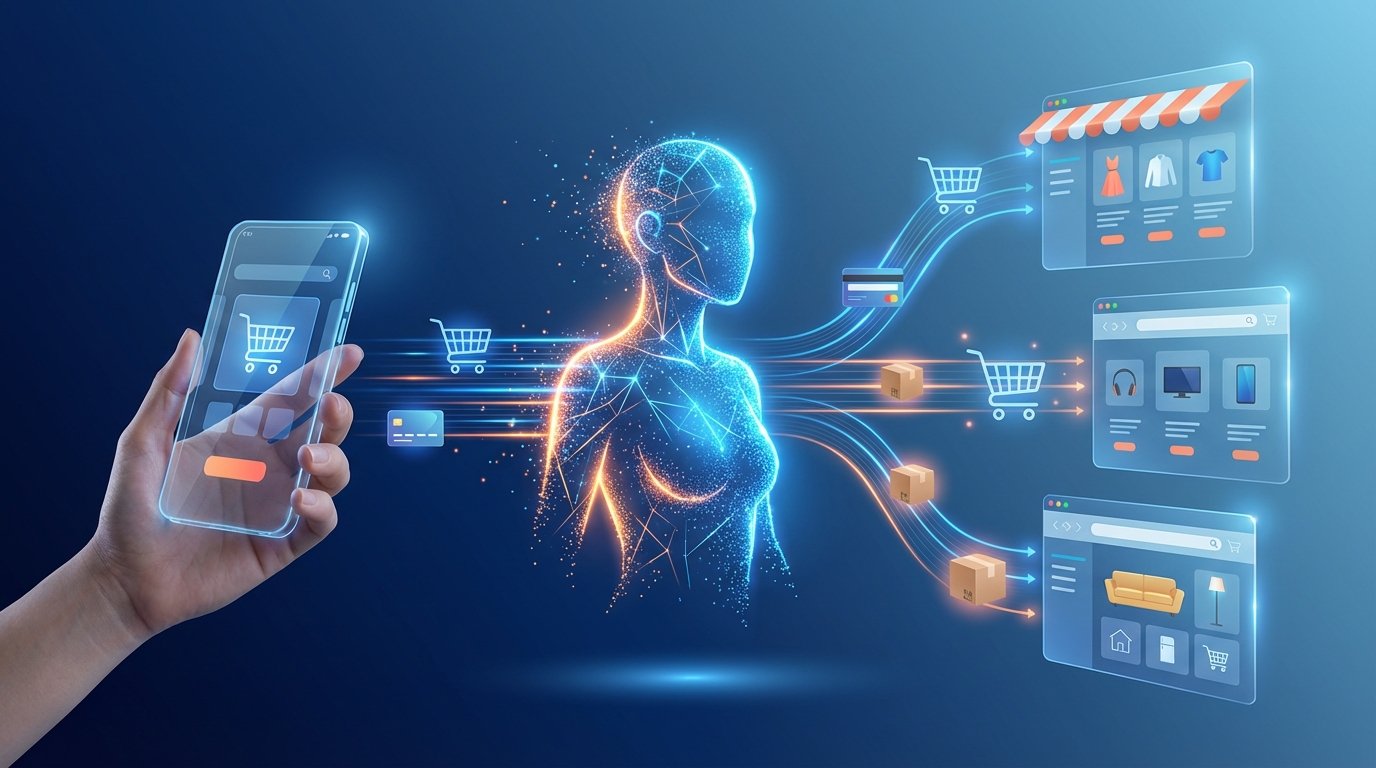
| Traditional E-Commerce | Agentic Commerce |
|---|---|
| Customer browses multiple sites | AI agent researches options |
| Manual price comparisons | Automatic cross-merchant comparison |
| Fill out checkout forms | Agent handles checkout |
| High cart abandonment (~70%) | Smooth, frictionless completion |
Industry pilots show conversion rates up to 2-4x higher when purchases happen through AI interfaces. Microsoft reports 3x improvements for Brand Agent sessions. Lowe's saw doubled conversions through their Mylow assistant.
Related Protocols
UCP works alongside other standards:
- Agent Payments Protocol (AP2): Handles secure, tokenized payments with support from 60+ partners
- Agent2Agent (A2A): Enables AI agents to communicate with each other
- Model Context Protocol (MCP): Transfers context between sessions for personalized experiences
What UCP Means for Magento Stores

Opportunities
Higher Conversions: Your complex Magento checkout, with custom fields, B2B logic, and regional shipping rules, becomes invisible to the customer. The AI handles friction that causes cart abandonment.
New Traffic Sources: Products from your Google Merchant Center feed appear in AI Mode in Search and the Gemini App. This reaches customers who never click traditional search results.
Your Rules Still Apply: Your Magento price rules, customer segments, and loyalty programs still work. When an AI agent processes a purchase, it queries your system. Your "15% off for returning customers" rule? The agent applies it.
Platform Flexibility: As an open standard, UCP is not locked to Google. ChatGPT, Copilot, and future AI platforms could adopt it. One integration, multiple channels.
Challenges
Reduced Website Traffic: If purchases happen in AI conversations, fewer people visit your Magento storefront. Your investment in custom themes and content marketing becomes less visible.
Google Dependency: While UCP is open, Google is the first mover. Your visibility depends on Merchant Center optimization and Google's algorithms.
Data Quality Requirements: AI agents need clean, detailed product data. Magento's flexibility means your catalog could have inconsistencies that worked for humans but confuse AI.
Less UX Control: Your brand experience gets compressed. The AI summarizes your product in two sentences. Business Agents offer some control, but the default experience is Google's interface.
Magento vs Shopify
Shopify benefits from being a UCP co-developer with native integration. Magento's flexibility remains a strength for complex use cases.
| Aspect | Magento | Shopify |
|---|---|---|
| Integration | Compatible (manual setup) | Native (co-developer) |
| B2B Capabilities | Strong, enterprise-ready | Limited |
| Multi-Store | Native support | Limited/costly |
| Custom Pricing Logic | Full control | Restricted |
| Long-term Flexibility | High | Low |
Real-World Scenarios
Quick Purchase
A customer asks Gemini: "I need a hardshell suitcase for a 2-week trip, under $300."
The AI agent discovers your product via Merchant Center, checks availability, calculates shipping, and recognizes a first-time buyer. It applies your "15% new customer" price rule. The customer confirms with Google Pay. The order flows into your Magento backend.
You keep: customer data, order management, fulfillment control. You lose: the chance to upsell on your product page.
Complex Delivery
A customer searches in AI Mode: "Large corner sofa, gray fabric, delivery next Saturday."
The agent finds your product. UCP's embedded checkout renders a mini-interface within the AI conversation showing available Saturday slots from your Magento shipping module. The customer selects, pays, and you handle delivery.
Magento's complex fulfillment logic is not a barrier. It is exposed through UCP capabilities.
Brand-Led Conversation
With Business Agents, your store gets its own AI chat presence in Google Search. A customer searching for "running shoes for marathon training" sees your branded chat option.
Your agent asks qualifying questions, then recommends specific products from your catalog. This preserves brand voice and expertise. Companies like Lowe's, Reebok, and Michaels already offer Business Agents.
Preparing Your Magento Store
What to Do Now
- Audit your product data: AI agents are as good as the information they receive. Clean, detailed, structured product feeds are the foundation
- Watch the pioneers: Walmart, Target, and Shopify merchants show what works and what fails. Learn from their experience
- Keep your website: UCP is an additional channel, not a replacement. Your storefront remains critical for brand building and direct relationships
- Consider Business Agents: If your store offers expertise or personalized service, a branded AI chat preserves what makes you special
Timeline
- Now (Q1 2026): US rollout in AI Mode and Gemini
- Q1-Q2 2026: Multi-item carts, loyalty integration, global expansion
- Mid-2026+: Full agentic capabilities, broader platform support
For stores running on managed Magento hosting, your infrastructure handles the API traffic from AI agents. Self-hosted stores need to ensure their servers can handle additional automated requests.
FAQ
What is the Universal Commerce Protocol?
UCP is Google's open standard that enables AI agents to complete purchases on behalf of users. It standardizes communication between AI agents, merchants, payment providers, and credential providers across the entire commerce ecosystem.
When did UCP launch?
Google announced UCP on January 11, 2026 at the National Retail Federation conference. It is available in the US through AI Mode in Google Search and the Gemini App. European rollout is expected Q1-Q2 2026.
Does UCP work with Magento?
Yes. UCP is platform-agnostic. Magento stores can participate through Google Merchant Center product feeds. Shopify has native integration as a co-developer, but Magento stores can connect through standard feed protocols.
Do I lose control of my customer data?
No. Merchants remain the merchant of record. You keep full control over customer data, pricing, fulfillment, and returns. Google does not sit between you and your customer. Transactions use tokenized payments and cryptographic consent proofs.
What conversion improvements does UCP deliver?
Early industry pilots report conversion rates 2-4x higher through AI-assisted shopping. Microsoft reports 3x improvements for Brand Agent sessions. Results vary by implementation and product category.
Will UCP replace my website?
No. UCP is an additional sales channel, not a replacement. Your website remains important for brand building, content marketing, SEO, and direct customer relationships. Think of UCP as a new storefront managed by AI.
What is a Business Agent?
A Business Agent is a branded AI chat presence for your store within Google Search. It lets you control the conversation, ask qualifying questions, and recommend specific products. Companies like Lowe's and Reebok already use Business Agents.
How do I prepare my Magento store for UCP?
Start with your Google Merchant Center product feed. Ensure clean, structured product data with accurate titles, descriptions, prices, and availability. Monitor how early adopters perform and consider implementing a Business Agent if your store offers expertise.
Is UCP only for Google?
UCP is an open standard. While Google is the first mover, other AI platforms (ChatGPT, Copilot) could adopt it. This means one integration could open multiple channels for your Magento store.
What protocols work alongside UCP?
UCP integrates with Agent Payments Protocol (AP2) for tokenized payments, Agent2Agent (A2A) for inter-agent communication, and Model Context Protocol (MCP) for session context transfer.
Conclusion
Google's Universal Commerce Protocol changes how consumers interact with online stores. AI agents handle purchases that used to require browsing, comparing, and checking out on your website. For Magento merchants, the question is whether your store will be one that AI agents can work with, or one they skip.
The stores that prepare now with clean data, structured feeds, and AI-friendly architecture will capture purchases that happen outside traditional websites. Start with your product feed, watch the early adopters, and plan your UCP integration for 2026.
For Magento stores that need their infrastructure ready for AI agent traffic, Magento managed hosting ensures your servers handle the additional API load from agentic commerce.