Magento Meta Tags Guide: How to Optimize Title & Description (Meta Keywords Are Dead)
[Updated: March 20, 2026]
Meta keywords are dead. Google confirmed it in 2009. Bing followed. Yet the field still sits in every Magento 2 admin panel, collecting dust.
This guide covers which meta tags matter in 2026, how to optimize them in Magento 2, and why you can ignore the meta keywords field for good.
Quick Answer
Magento meta keywords = An obsolete HTML tag that Google has ignored since September 2009. No ranking impact, no crawling signal, no SEO value.
What matters instead: Meta title (50-60 characters), meta description (150-160 characters), canonical URLs, robots tags, structured data
Use meta keywords? Only if you target Baidu (China). For Google, Bing, Yandex, and all Western markets: skip it.
What Are Magento Meta Tags?
Meta tags are HTML elements in the <head> section of every page. They tell search engines and browsers what the page is about. Magento 2 provides three meta tag fields in the admin panel for every product, category, and CMS page.
| Tag | SEO Impact (2026) | Purpose |
|---|---|---|
| Meta Title | High | Appears in browser tabs and search results. Affects rankings and click-through rate. |
| Meta Description | Medium | Appears below the title in SERPs. Affects click-through rate. Not a direct ranking factor. |
| Meta Keywords | None | Google, Bing, and Yahoo ignore this tag. Only Baidu still considers it a ranking factor. |
Beyond these three fields, several other meta tags matter for Magento stores: canonical URLs, robots directives, Open Graph tags, and hreflang attributes.
Meta Keywords: Why They Are Dead
Google published an official blog post on September 21, 2009, confirming it "does not use the keywords meta tag in web ranking." Matt Cutts, then Head of Webspam at Google, stated the search engine "completely ignores meta keywords."
The reason was abuse. Webmasters stuffed hundreds of irrelevant keywords into the tag. Search engines could not trust the data.
Search Engine Support in 2026
| Search Engine | Status | Details |
|---|---|---|
| Ignored | Since 2009 | |
| Bing | Ignored | Since 2014 |
| Yahoo | Ignored | Uses Bing's index |
| DuckDuckGo | Ignored | Uses Bing's index |
| Baidu | Still a ranking factor | Active in Chinese market |
| Yandex | Negligible impact | Weight reduced to near zero |
Unless your Magento store targets the Chinese market through Baidu, meta keywords provide zero practical value. Baidu still treats meta keywords as a ranking signal. Yandex has reduced their weight to near zero, making them not worth the effort even for the Russian market.
Why the Field Still Exists in Magento
Legacy. Magento has carried the field since version 1.x. Adobe has not removed it from the admin panel. The official Adobe Commerce documentation remains diplomatic, stating "some search engines ignore meta keywords, others continue to use them."
In practice, every search engine serving Western markets ignores the tag.
Does Magento Internal Search Use Meta Keywords?
No. Magento 2.4.0 and later require OpenSearch or Elasticsearch for catalog search. These engines index product names, descriptions, SKUs, and attributes marked "Use in Search." Meta keywords are not part of the search index.
The old MySQL-based catalog search supported meta keywords before Magento 2.4.0. Adobe removed MySQL search in July 2020 with the 2.4.0 release. It is no longer available.
Meta Title: The Most Important Meta Tag
The meta title appears in browser tabs, search results, and social media shares. It is the strongest on-page SEO signal after content itself.
Best practices for Magento 2:
- Length: 50-60 characters (about 580-600 pixels on desktop)
- Keyword placement: Put the primary keyword at the beginning
- Uniqueness: Every page needs a distinct meta title
- No duplicates: Check for duplicate titles across your catalog
- Brand: Add your store name at the end if space allows
Google renders titles based on pixel width, not character count. Titles that exceed 600 pixels get truncated with an ellipsis.
Google also modifies title tags more than 60% of the time to improve clarity and match search intent (Zyppy study, confirmed by Search Engine Land). Well-structured titles with natural keyword placement are more likely to survive unchanged. Test yours with a SERP preview tool before publishing.
Meta Description: Your Click-Through Rate Lever
Meta descriptions do not affect rankings. Google confirmed this multiple times. But they affect click-through rate, which makes them valuable.
A good meta description acts as ad copy for your search listing.
Best practices for Magento 2:
- Length: 150-160 characters (up to ~920 pixels on desktop)
- Call-to-action: Include one ("Shop now," "Learn how," "Compare prices")
- Primary keyword: Use it once, natural
- Unique per page: Avoid duplicate descriptions across your catalog
Google rewrites meta descriptions about 63% of the time to better match user queries (Ahrefs study). A strong, intent-aligned description increases the chance Google keeps yours and improves click-through rate.
Other Meta Tags That Matter in 2026
Canonical URLs: Prevent Duplicate Content
Magento stores often create multiple URLs for the same product through categories, filters, and URL parameters. The canonical tag tells search engines which URL is the "original."
Where to configure:
Stores > Configuration > Catalog > Catalog > Search Engine Optimization
Enable "Use Canonical Link Meta Tag For Categories" and "Use Canonical Link Meta Tag For Products."
Without proper canonical tags, Google may index multiple versions of the same page. This dilutes ranking signals and wastes crawl budget. For a complete walkthrough, see our guide to canonical URLs in Magento 2.
Robots Meta Tag: Control What Gets Indexed
The robots meta tag tells search engines whether to index a page and follow its links.
| Directive | Effect |
|---|---|
index, follow |
Index the page and follow all links (default) |
noindex, follow |
Do not index the page, but follow links |
noindex, nofollow |
Do not index, do not follow links |
When to use noindex in Magento:
- Filtered category pages (color, size filters)
- Internal search results pages
- Customer account pages
- Cart and checkout pages
Configure your robots.txt file to block crawling of admin, API, and checkout paths.
Open Graph Tags: Social Media Previews
When someone shares your product page on Facebook, LinkedIn, or Twitter, Open Graph tags control the preview card.
Magento 2 does not include Open Graph tags by default. You need a third-party extension or custom theme modifications.
Essential Open Graph tags:
-
og:titlefor the product or page title -
og:descriptionfor a short description -
og:imagefor the featured image (1200x630 pixels recommended) -
og:urlfor the canonical URL
Hreflang Tags: International Stores
If your Magento store serves multiple languages or regions, hreflang tags tell Google which version to show in each market. Without them, Google may display the wrong language version in search results.
Magento 2 does not generate hreflang tags out of the box. Third-party SEO extensions or custom development are required.
Editing Meta Tags in Magento 2
For Products
Step 1: Open the Product
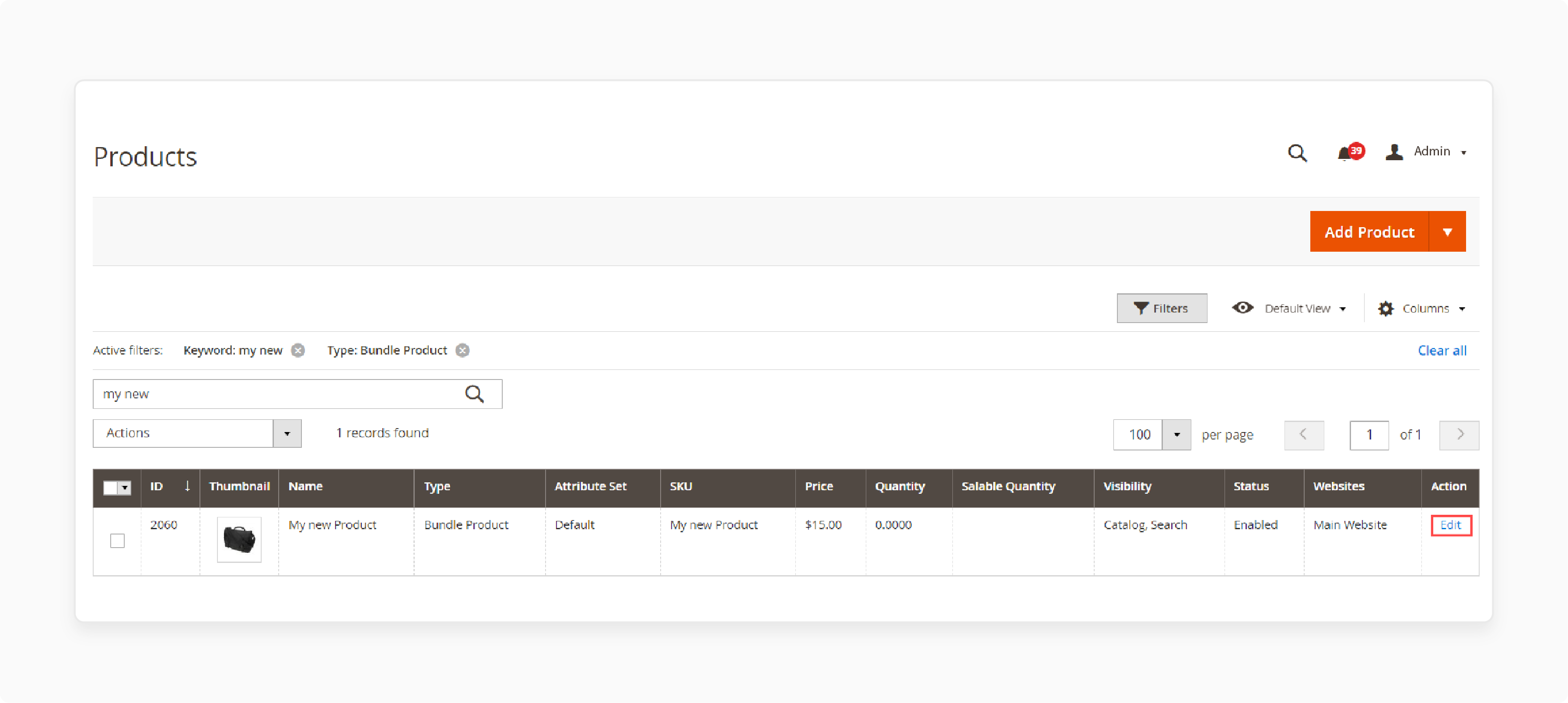
Log in to your Magento 2 admin panel. Go to Catalog > Products and select the product.
Step 2: Find the SEO Section
Scroll down to the Search Engine Optimization section.
Step 3: Enter Your Meta Tags
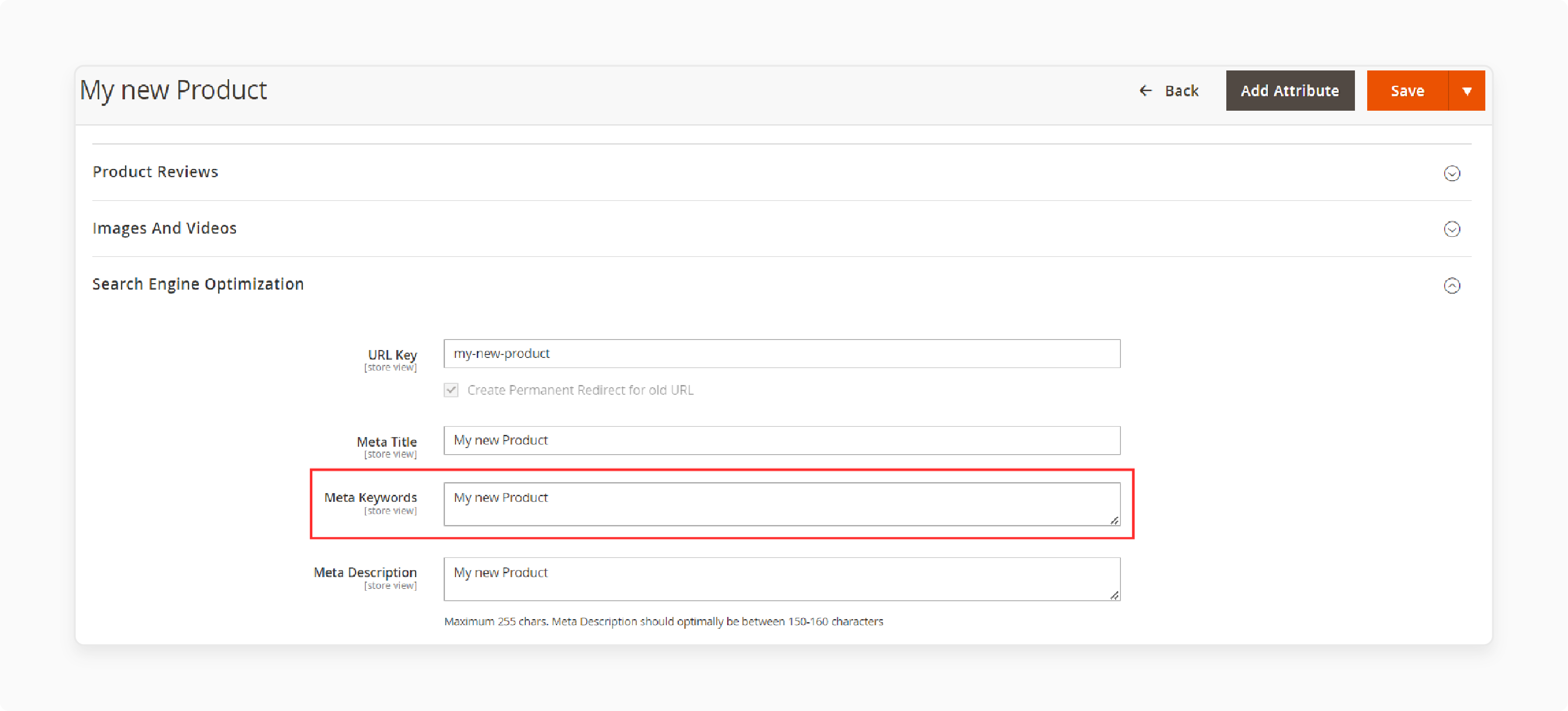
- Fill in Meta Title (50-60 characters)
- Fill in Meta Description (150-160 characters)
- Leave Meta Keywords empty
- Click Save
For Categories
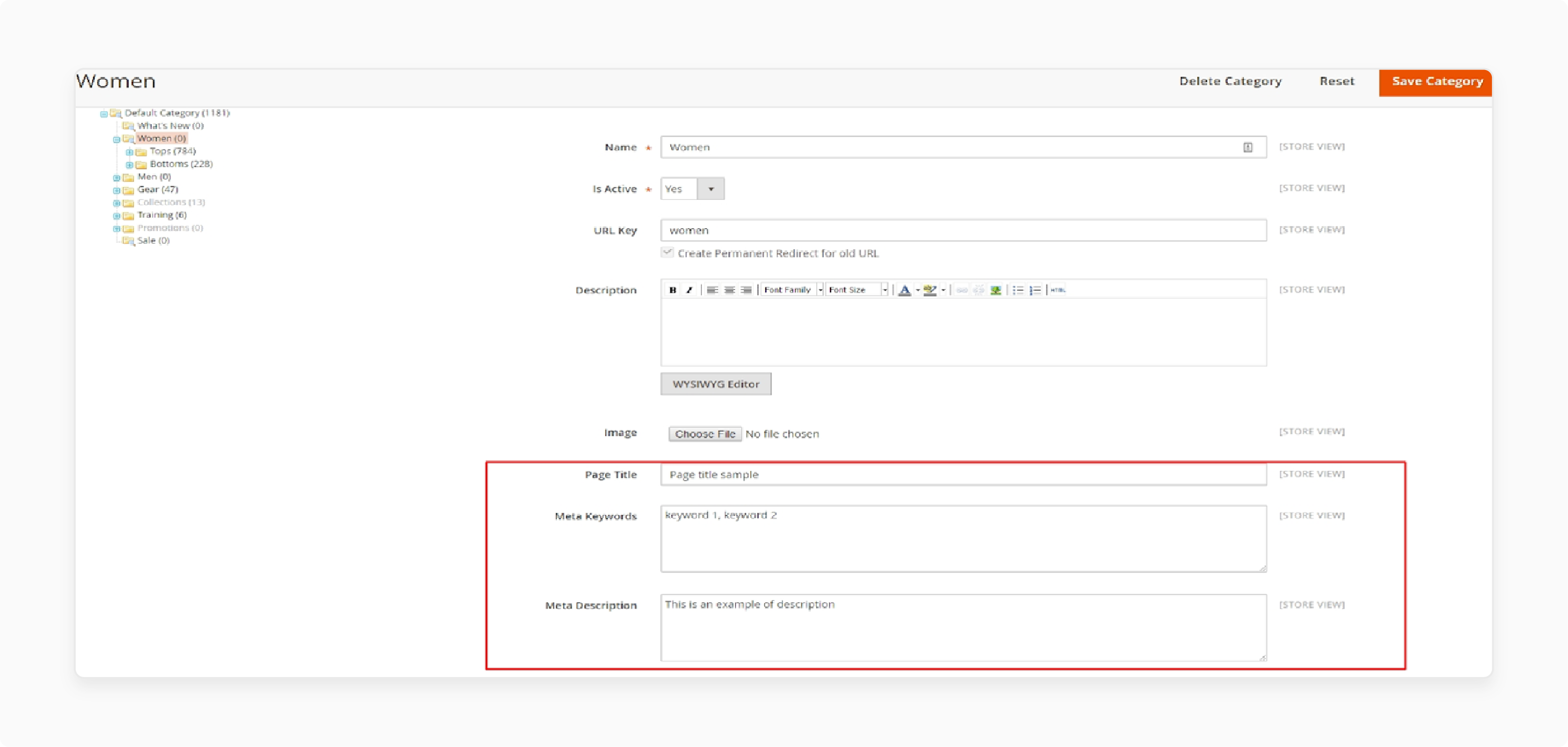
- Go to Catalog > Categories
- Select your category
- Open the Search Engine Optimization section
- Fill in Meta Title and Meta Description
- Click Save
For CMS Pages
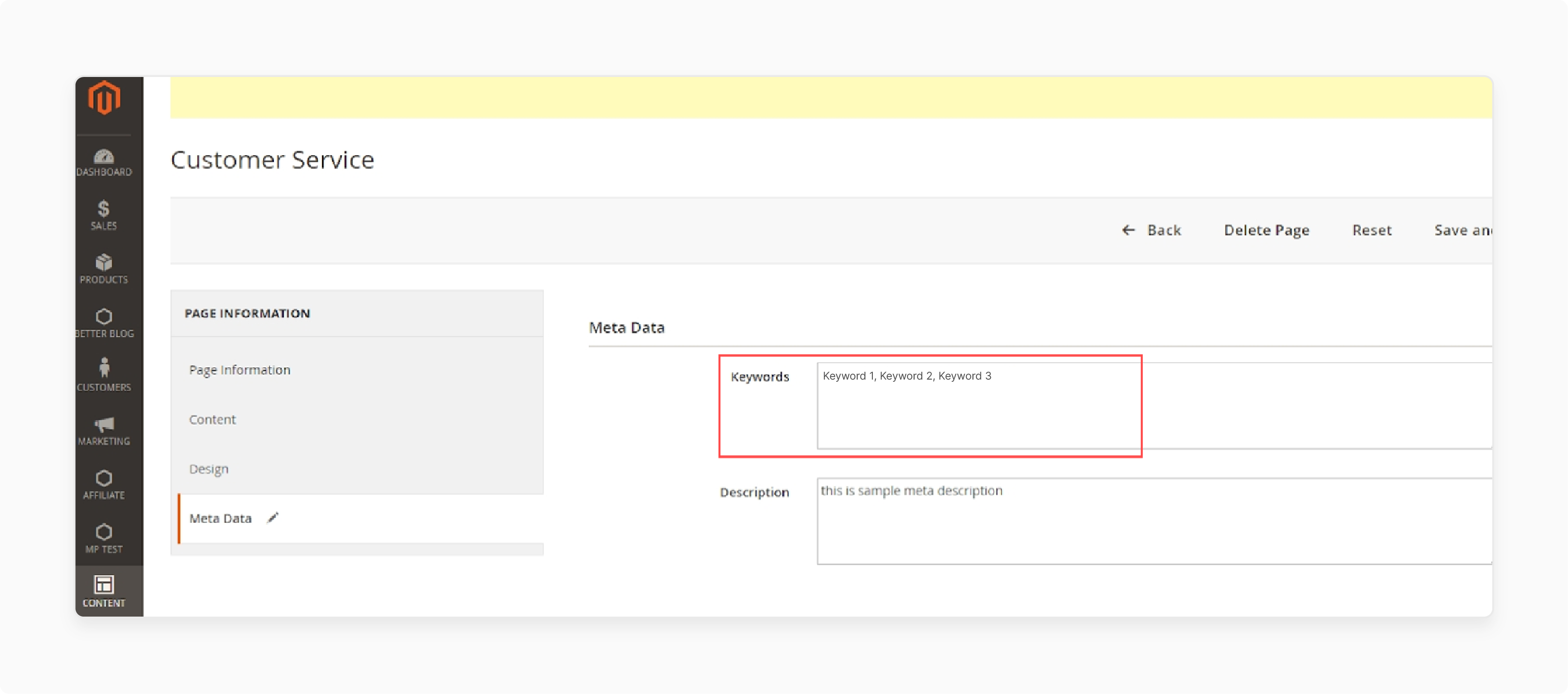
- Go to Content > Pages
- Select the page
- Open the Meta Data section
- Fill in Meta Title and Meta Description
- Click Save Page
Meta Tags Templates: Automation at Scale
Setting meta titles and descriptions for hundreds of products by hand is not realistic. Magento 2 offers metadata templates that generate tags based on product attributes.
Setting Up SEO Rules
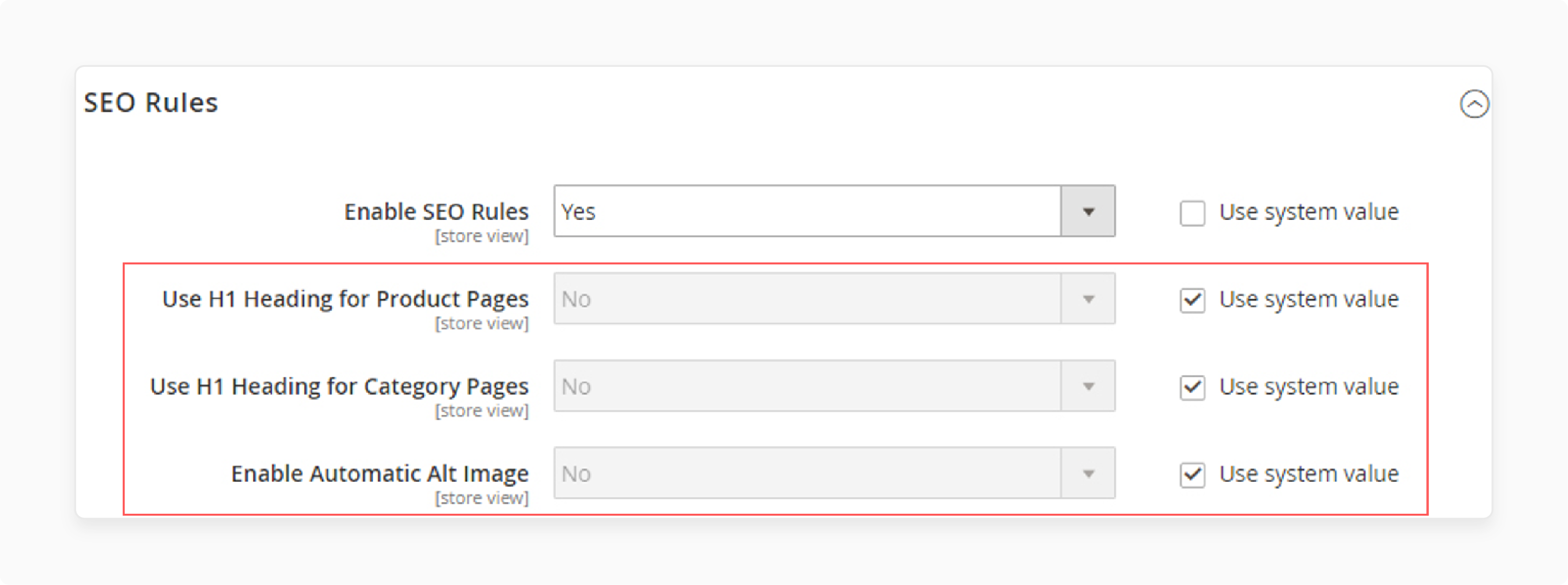
Enable the H1 Heading option for products and category pages under Stores > Configuration > Catalog > Catalog > Search Engine Optimization.
Creating Template Rules
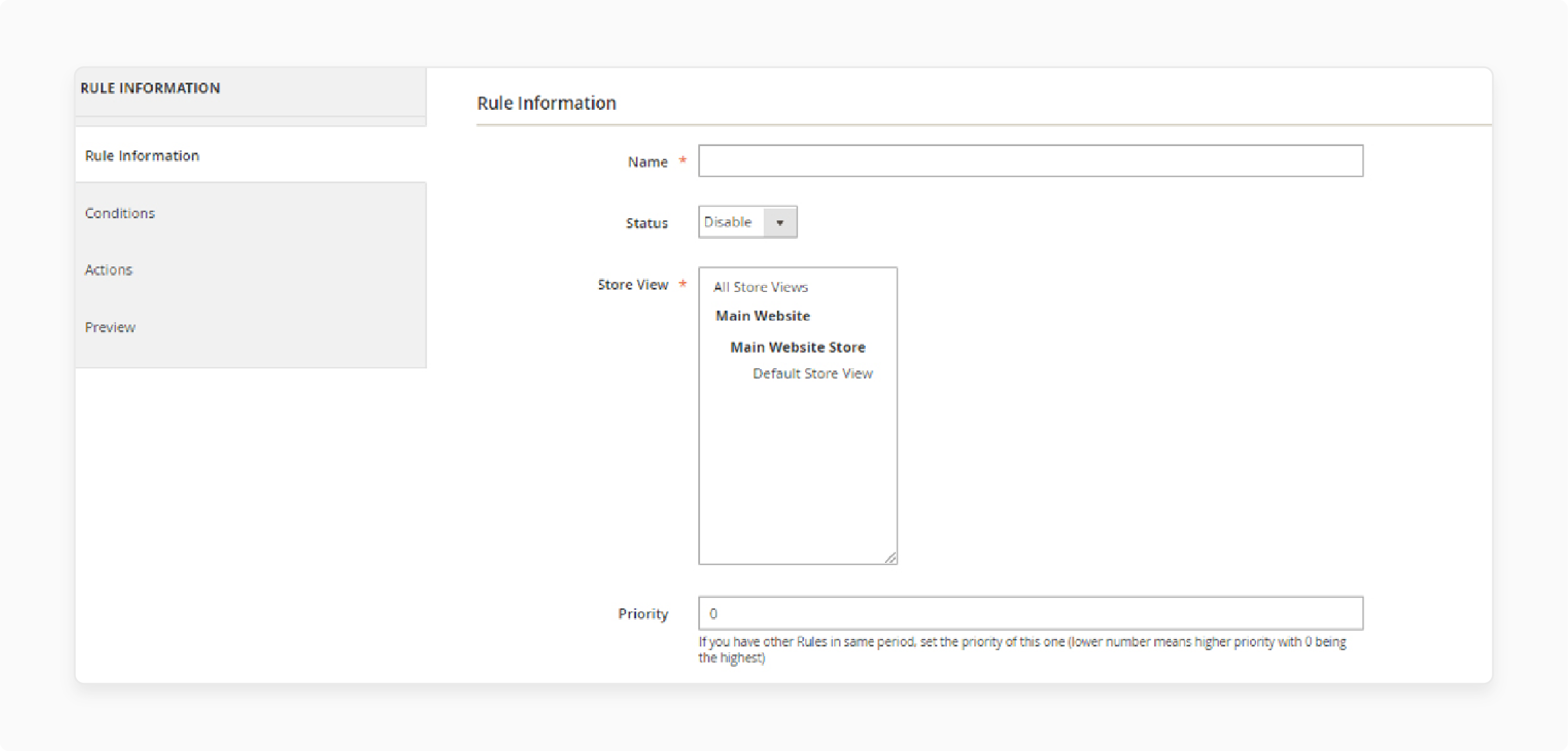
Create rules for product pages, category pages, CMS pages, and layered navigation using dynamic variables:
| Variable | Output |
|---|---|
[Product Name] |
The product name |
[Category Name] |
The parent category |
[Price] |
Current price |
[SKU] |
Product SKU |
Meta Title Template Example
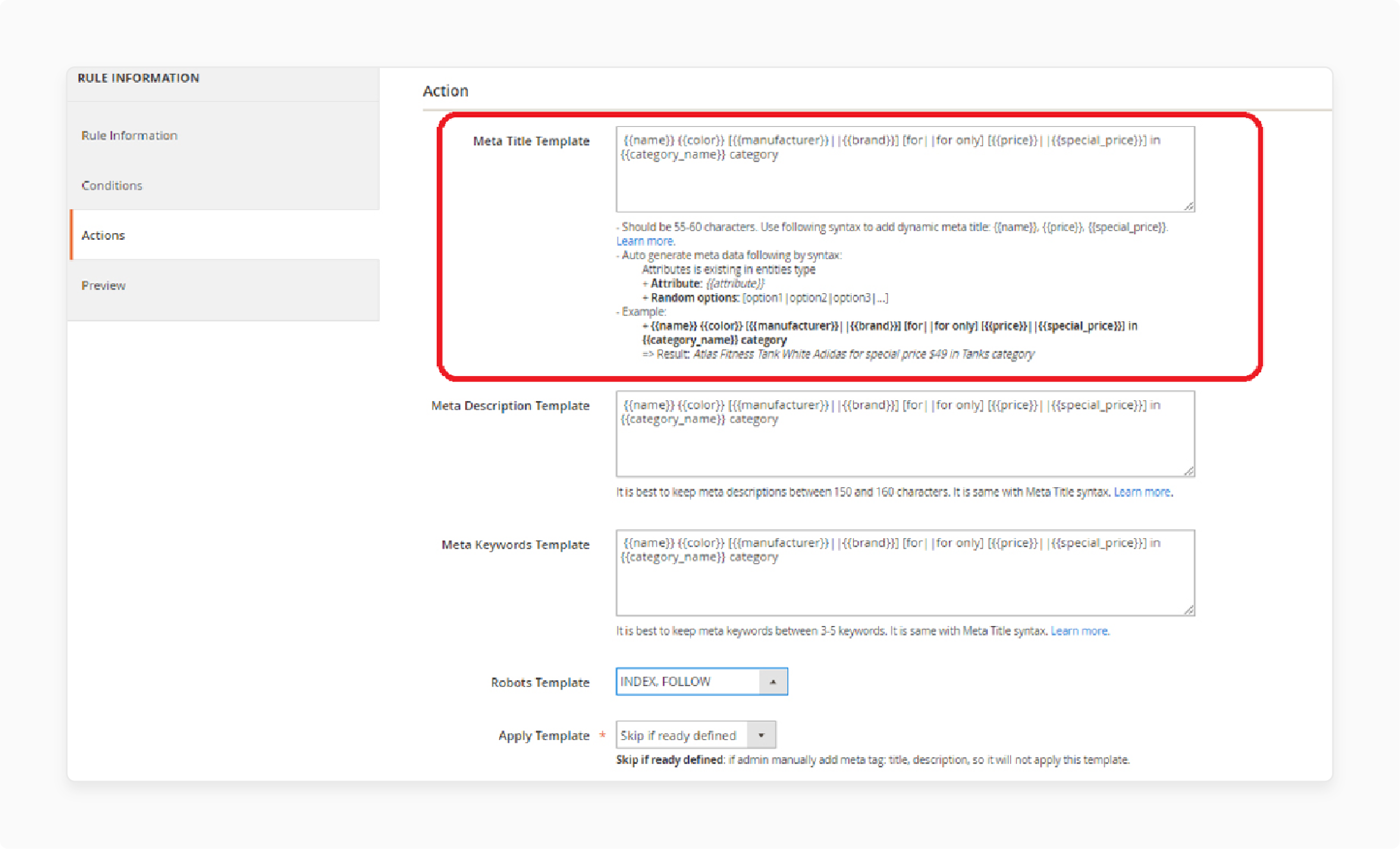
Example pattern: Buy [Product Name] | [Category] | Your Store
This generates unique titles for every product without manual input.
Meta Description Template Example
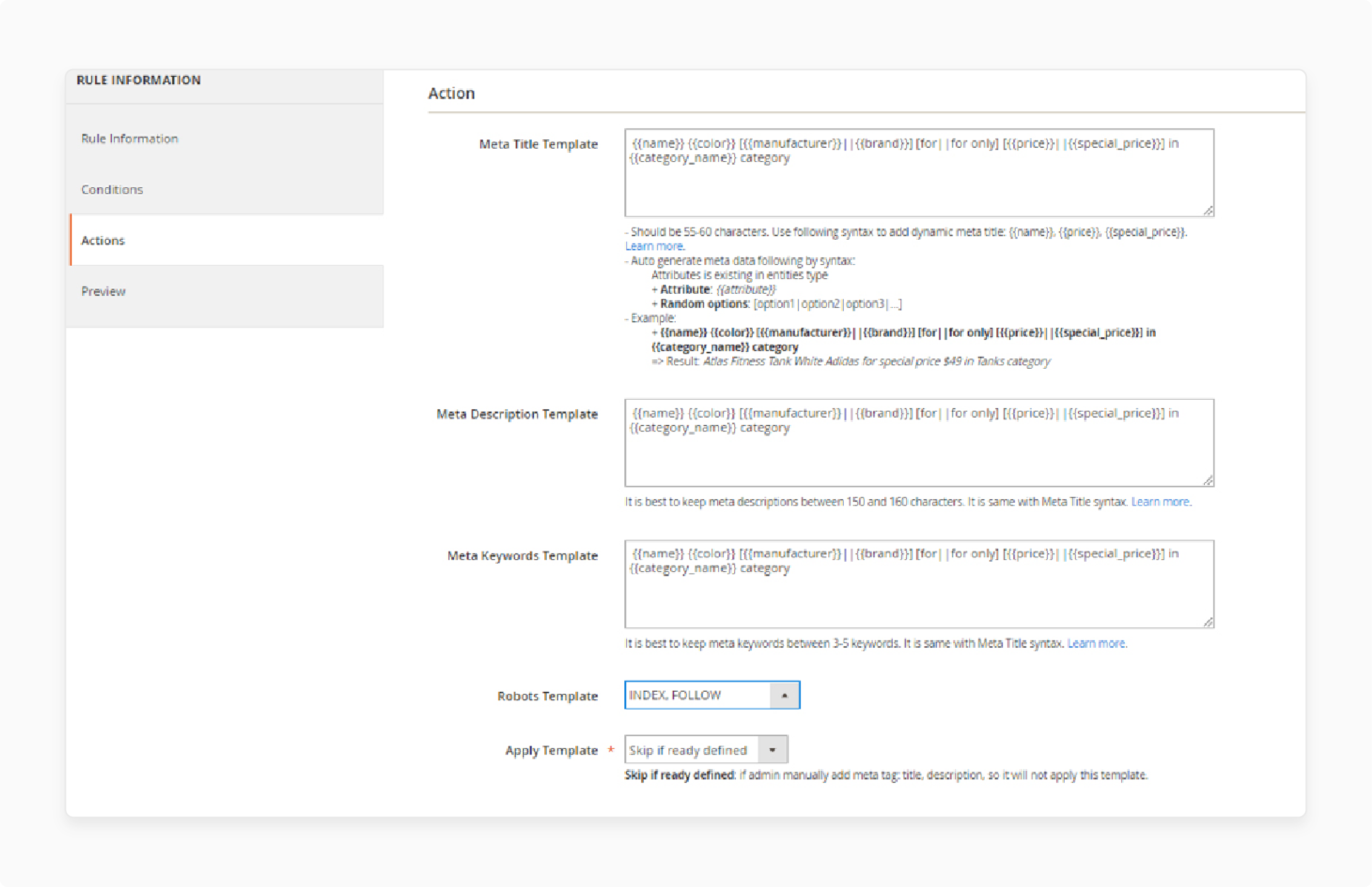
Example pattern: Shop [Product Name] for [Price]. Free shipping on orders over $50. [Category] at Your Store.
Structured Data: Beyond Meta Tags
Structured data (Schema.org markup) gives search engines explicit information about your content. It enables rich snippets in search results: star ratings, prices, availability, and FAQ accordions.
Key schema types for Magento stores:
| Schema Type | What It Shows in SERPs |
|---|---|
| Product | Price, availability, review stars |
| BreadcrumbList | Navigation path |
| FAQPage | Expandable FAQ answers |
| Organization | Company info, logo |
| HowTo | Step-by-step instructions |
Structured data replaced meta keywords as the way to communicate content meaning to search engines. Meta keywords used a comma-separated list. Structured data does the same job with precision, context, and machine-readable format.
Magento 2.4.8 includes basic Product and BreadcrumbList schema by default. For FAQPage, Organization, and other types, add custom JSON-LD to your theme or use an extension.
FAQ
Are meta keywords still relevant for SEO in 2026?
No. Google has ignored meta keywords since September 2009. Bing and Yahoo do the same. The tag has zero effect on rankings, crawling, or indexing. Only Baidu (China) still treats it as a ranking factor. Yandex has reduced its weight to negligible levels.
Should I fill in the meta keywords field in Magento?
Only if your store targets the Chinese market through Baidu. For all other markets, leave it empty. Your time is better spent on meta title and description optimization.
Does Magento use meta keywords for internal product search?
No. Magento 2.4.0 and later require OpenSearch or Elasticsearch. These search engines do not index meta keywords. They use product name, description, SKU, and searchable attributes.
How long should my meta title be?
Aim for 50-60 characters (about 580-600 pixels). Google truncates titles based on pixel width and modifies them more than 60% of the time. Place your primary keyword at the start and keep titles natural.
How long should my meta description be?
Keep it between 150-160 characters. Include a call-to-action and your primary keyword. Google rewrites descriptions about 63% of the time, but intent-aligned descriptions are more likely to be kept.
What is the difference between meta tags and structured data?
Meta tags (title, description) appear in the HTML <head> and influence how your page shows in search results. Structured data (Schema.org JSON-LD) provides machine-readable information that enables rich snippets like star ratings and pricing.
Do I need canonical tags in Magento?
Yes. Magento creates multiple URLs for products through categories and filters. Without canonical tags, Google may index duplicates. Enable canonical tags in Stores > Configuration > Catalog > Search Engine Optimization.
Can meta keywords hurt my SEO?
Stuffed meta keywords can signal low-quality SEO practices. Some auditing tools flag them as a minor issue. There is no evidence they cause ranking penalties, but they offer no benefit either.
What meta tags does Magento 2 support natively?
Magento 2 supports meta title, meta description, and meta keywords for products, categories, and CMS pages. It also generates canonical URLs and robots directives. Open Graph tags require extensions or custom development.
How do I automate meta tags for a large Magento catalog?
Use Magento's built-in meta tag templates under Stores > Configuration > Catalog > Search Engine Optimization. Templates use variables like [Product Name] and [Price] to generate unique meta tags at scale.
Summary
Meta keywords serve no purpose for Google, Bing, or Yahoo in 2026. Google confirmed this position in 2009 and has never reversed it.
Focus your SEO effort on the meta tags that produce results:
- Meta title (50-60 characters) for rankings and click-through rate
- Meta description (150-160 characters) for click-through rate
- Canonical URLs to prevent duplicate content issues
- Robots directives to control indexing
- Structured data to enable rich snippets
Leave the meta keywords field empty in your Magento admin. Spend that time on content quality, reliable Magento hosting, and structured data instead.
For large catalogs, use Magento's meta tag templates to generate titles and descriptions at scale. Pair these with a manual review of your most important pages to maximize search visibility.