Magento Commerce Cloud: Benefits, Features, and Pricing
[Updated: March 03, 2026] Adobe Commerce Cloud license costs range from an estimated $40K to $200K+ per year, but is it the right choice? This guide compares all three Magento editions, breaks down real costs, and covers the new ACaaS SaaS option for 2026.
What is Adobe Commerce Cloud?
Adobe Commerce Cloud (formerly Magento Commerce Cloud) = Adobe's managed PaaS ecommerce platform running on AWS infrastructure. You get the full Adobe Commerce feature set plus cloud hosting, automated deployment, and CDN in one package.
Perfect for: Mid-market to enterprise merchants, B2B companies needing custom catalogs, stores expecting traffic spikes or rapid growth.
Not ideal for: Small stores under $1M GMV, businesses needing full infrastructure control, teams with tight budgets.
Adobe Commerce Cloud is a Platform as a Service (PaaS) that combines the Adobe Commerce application with managed cloud infrastructure. Adobe handles server provisioning, security patches, and platform updates. You focus on running your store.
The platform runs on Amazon Web Services (AWS) with Fastly CDN for global content delivery. It includes tools like New Relic for performance monitoring, Blackfire for PHP profiling, and RabbitMQ for message queuing out of the box.
Adobe acquired Magento in 2018 and rebranded the product line. The naming can be confusing:
- Magento Open Source = Free, self-hosted community edition
- Adobe Commerce (formerly Magento Commerce) = Licensed, self-hosted enterprise edition
- Adobe Commerce Cloud (formerly Magento Commerce Cloud) = Licensed enterprise edition with managed cloud hosting
All three editions share the same core PHP codebase. The difference is features, support, and hosting.
Three Editions Compared
| Feature | Magento Open Source | Adobe Commerce | Adobe Commerce Cloud |
|---|---|---|---|
| License Cost | Free | $22K-$125K+/year | $40K-$200K+/year |
| Hosting | Self-managed | Self-managed | AWS (Adobe-managed) |
| B2B Features | No | Yes | Yes |
| Page Builder | Basic | Advanced | Advanced |
| Customer Segmentation | No | Yes | Yes |
| Staging & Preview | No | Yes | Yes |
| Fastly CDN | No | No | Included |
| WAF & DDoS | No | No | Included |
| New Relic APM | No | No | Included |
| Automated Deployment | No | No | Git-based CI/CD |
| PCI Compliance | Your responsibility | Your responsibility | Adobe-managed (Level 1) |
| 24/7 Support | Community only | Adobe Support | Adobe Support + Cloud Ops |
The Cloud edition bundles hosting, security, and DevOps tooling into the license fee. For stores that would otherwise spend $3K-$10K per month on managed Magento hosting, the total cost of ownership gap shrinks.
Key Features of Adobe Commerce Cloud
Cloud Infrastructure and Deployment
Adobe Commerce Cloud runs on a pre-provisioned AWS environment. Each project gets:
- Integration environments for development and testing (up to 8 active branches)
- Staging environment that mirrors production
- Production environment with auto-scaling
Deployment follows a Git-based workflow. Push code to a branch, and the platform builds, tests, and deploys. The Magento Cloud CLI tool (magento-cloud) manages environments, SSH access, and configuration from the terminal. Developers and system administrators use the CLI for cloud projects, environment variables, and code changes across integration environments.
Security and Compliance
The platform provides PCI Level 1 compliance as a certified solution provider. Security features include:
- Fastly Web Application Firewall (WAF) with OWASP rule sets
- DDoS protection at the edge layer
- TLS/SSL certificate management
- Automated security patches and isolated patch releases
For stores processing payment data, this removes the burden of managing PCI compliance at the infrastructure level.
Performance Stack
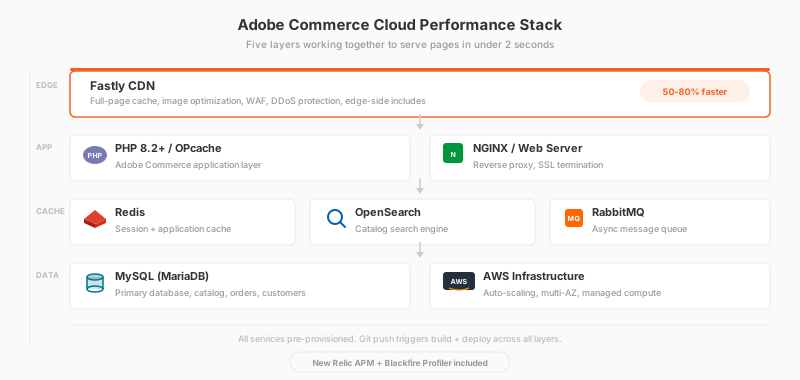
Adobe Commerce Cloud includes a multi-layer performance stack:
- Fastly CDN with full-page caching (Varnish-based), image optimization, and edge-side includes
- Redis for session storage and application cache
- Elasticsearch/OpenSearch for catalog search
- RabbitMQ for asynchronous message processing
Fastly alone reduces page load times by 50-80% for cached content. Combined with PHP 8.2+ and OPcache, production stores serve most pages in under 2 seconds.
B2B Commerce
The Cloud edition includes the full B2B module suite:
- Company accounts with role-based permissions
- Custom pricing and shared catalogs per company
- Quote management with negotiation workflows
- Requisition lists for repeat purchasing
- Purchase order approval workflows
Content and Merchandising
Page Builder provides drag-and-drop content creation. Content Staging lets merchants schedule promotions, pricing changes, and CMS updates ahead of time with preview before going live.
Adobe Sensei powers product recommendations and visual search. Live Search delivers fast, AI-driven catalog search results.
You can customize the storefront, checkout workflow, and admin configuration without touching core code. The platform supports headless commerce via REST and GraphQL APIs for teams building custom frontends.
Adobe Commerce as a Cloud Service (ACaaS)
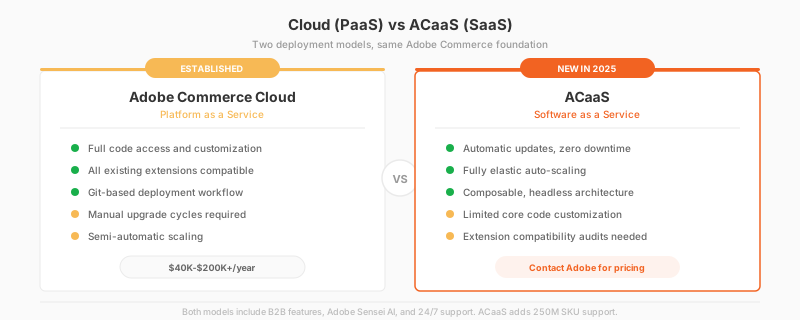
Adobe Commerce as a Cloud Service reached general availability (GA) in June 2025. It is a fully managed SaaS offering that goes beyond the existing PaaS model and receives monthly releases with continuous updates.
| Aspect | Cloud (PaaS) | ACaaS (SaaS) |
|---|---|---|
| Hosting Model | Managed PaaS (shared responsibility) | Fully managed SaaS |
| Updates | Manual, planned upgrade cycles | Automatic, continuous (monthly) |
| Architecture | Monolithic (customizable) | Composable, headless |
| Storefront | Luma or custom frontend | Edge Delivery Services + Commerce Storefront |
| Scalability | Semi-automatic | Fully elastic (auto-scaling) |
| Customization | Full code access | API-first, modular extensions |
| Edge Delivery | Fastly CDN | Edge-hosted components |
ACaaS supports up to 250 million SKUs per instance and 30,000 unique price points per SKU. It includes B2B drop-in components for company management, purchase orders, and quote management on Edge Delivery Services. Adobe positions ACaaS as the recommended path for new implementations.
The trade-off: ACaaS restricts direct core code access. The Luma storefront is not supported. Existing third-party modules need compatibility audits. Teams accustomed to deep Magento customization should evaluate whether the composable architecture fits their workflow before migrating.
For official documentation, see the ACaaS Overview, Release Notes (monthly updates, e.g. Feb 2026), and Migration Guidance (Bulk Data Tool available by request since Q1 2026).
How Much Does Adobe Commerce Cloud Cost?
Adobe does not publish fixed pricing. All quotes are customized based on your Gross Merchandise Value (GMV), Average Order Value (AOV), and selected features. The numbers below are third-party market estimates for 2026, not official Adobe prices. Always request a quote from Adobe for accurate pricing.
Adobe Commerce Cloud (PaaS) Estimated Pricing by GMV
| Annual GMV | Estimated License Cost | Notes |
|---|---|---|
| < $1M | ~$40,000 | Entry-level Cloud tier |
| $1M-$5M | ~$55,000-$80,000 | Mid-market |
| $5M-$10M | ~$80,000-$120,000 | Enterprise |
| $10M-$25M | ~$120,000-$190,000 | Large enterprise |
| > $25M | $190,000+ | Custom negotiation |
Self-Hosted Adobe Commerce
| Edition | Estimated License Cost |
|---|---|
| Magento Open Source | Free (hosting separate) |
| Adobe Commerce | $22,000-$125,000+/year (hosting separate) |
| ACaaS (SaaS) | No public pricing yet. Contact Adobe. |
These estimates are based on third-party analyses for 2026 (elogic.co, webdesksolution.com). Adobe adjusts pricing by GMV, AOV, region, contract terms, and negotiated discounts. Actual costs may differ.
These are license costs only. Budget for:
- Implementation: $50K-$500K+ depending on complexity
- Extensions and integrations: $5K-$50K+ per year
- Agency/development support: $10K-$100K+ per year
For the self-hosted editions (Open Source and Commerce), you also need hosting infrastructure. A production Magento store requires 24-32GB RAM minimum, SSD storage, and a properly configured LEMP stack. Managed hosting providers handle this for $300-$2,000+ per month.
The Cloud edition bundles hosting into the license. But the total cost is higher than self-hosting with a managed provider for many mid-market stores.
Bottom line: Request a quote from Adobe. Compare the total cost of ownership against self-hosted Adobe Commerce with dedicated Magento hosting.
Who Should Choose Adobe Commerce Cloud?
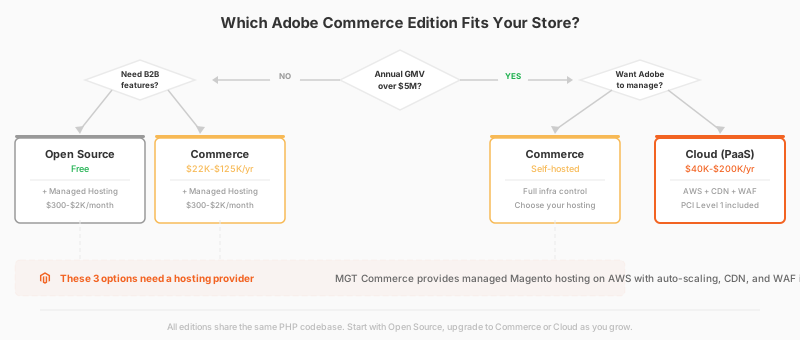
Choose Cloud if:
- Your store generates enough GMV that the $40K-$200K+ license represents a small share of revenue (often $5M+ GMV, but varies by margin)
- You need PCI Level 1 compliance without managing it yourself
- Your team wants Git-based deployment with staging environments included
- You plan to use B2B features, Content Staging, or Adobe Sensei
- You expect seasonal traffic spikes and need elastic scaling
Choose self-hosted Adobe Commerce (or Open Source) with managed hosting if:
- You want the same Commerce features at lower total cost
- Your team needs full control over server configuration, PHP versions, and caching layers
- You prefer choosing your own hosting provider, CDN, and monitoring stack
- Your budget fits better with $300-$2,000/month hosting plus a Commerce license
Both paths deliver the same application. The difference is who manages the infrastructure and what's bundled into the price. Many mid-market stores (under $5M GMV) achieve lower total cost of ownership with self-hosted Adobe Commerce and a specialized Magento hosting provider.
Starter vs Pro Plans
Adobe Commerce Cloud offers two cloud account tiers, Starter and Pro, each designed for different business scales.
Starter: Up to 4 active environments (master as production + staging + up to 2 active integration branches). No dedicated high-availability architecture. Suitable for smaller deployments and teams getting started with Adobe Commerce on cloud infrastructure. See the Starter architecture for details.
Pro: Dedicated integration environment supporting up to 2 active branches (primary + one additional), plus separate staging and production environments with 3-node high-availability architecture (redundant nodes across AWS/Azure Availability Zones, HAProxy load balancing, Galera DB cluster, etc.). Includes enhanced support, more resources, and access to the cloud console for advanced monitoring. Pro is the standard for enterprise Magento 2 stores. See the Pro architecture for details.
Most enterprise merchants choose Pro for the HA setup and additional environments. Both plans include the same core Adobe Commerce features and can be upgraded from Starter to Pro.
Frequently Asked Questions
What is Magento Commerce Cloud?
Magento Commerce Cloud is the former name of Adobe Commerce Cloud. Adobe acquired Magento in 2018 and rebranded all products. The platform is now called Adobe Commerce on cloud infrastructure.
How much does Magento Cloud cost?
Adobe does not publish fixed pricing. Third-party estimates for 2026 range from about $40,000 per year (for stores under $1M GMV) to $200,000+ per year (for large enterprises). Pricing depends on GMV, AOV, and selected features. For ACaaS (SaaS), no public estimates exist yet. Always request a quote from Adobe for accurate numbers.
Is Magento now Adobe?
Yes. Adobe acquired Magento in May 2018 for $1.68 billion. Magento Open Source remains free and community-maintained. The commercial editions are now branded as Adobe Commerce and Adobe Commerce Cloud.
What is the difference between Adobe Commerce and Adobe Commerce Cloud?
Adobe Commerce is the self-hosted enterprise edition. You buy the license and manage your own hosting. Adobe Commerce Cloud bundles the same software with managed AWS hosting, Fastly CDN, WAF, and automated deployment.
Is Adobe Commerce Cloud worth it?
It depends on your GMV, compliance needs, and team. Stores with complex B2B requirements or strict PCI obligations benefit from the bundled infrastructure. For smaller or mid-market stores, self-hosted Magento Open Source or Adobe Commerce with managed hosting delivers the same core features at lower total cost of ownership.
What is Adobe Commerce as a Cloud Service (ACaaS)?
ACaaS is Adobe's fully managed SaaS ecommerce platform, generally available since June 2025. Unlike the PaaS Cloud edition, ACaaS offers automatic monthly updates, composable headless architecture via Edge Delivery Services, and fully elastic scaling. It supports up to 250 million SKUs per instance.
Can I migrate from Magento Commerce Cloud to ACaaS?
Adobe provides migration tooling for iterative data migrations, with dedicated bulk migration tools available since Q1 2026. Audit your existing extensions and customizations for compatibility before planning a migration. The Luma storefront is not supported on ACaaS.
What hosting does Adobe Commerce Cloud use?
Adobe Commerce Cloud runs on Amazon Web Services (AWS). The infrastructure includes pre-provisioned environments with PHP, MySQL (MariaDB), Redis, Elasticsearch/OpenSearch, and RabbitMQ.
Is Magento B2B or B2C?
Both. Magento Open Source handles B2C out of the box. Adobe Commerce and Adobe Commerce Cloud add B2B features: company accounts, custom pricing, shared catalogs, purchase orders, and quote negotiation.
What is the difference between Magento Cloud and Shopify Plus?
Magento Cloud (Adobe Commerce Cloud) offers full code access, unlimited customization, and self-managed deployment on AWS. Shopify Plus is a closed SaaS platform with limited customization but faster setup. Cloud suits complex, custom stores. Shopify Plus suits merchants who prefer simplicity over flexibility.