Magento PIM Integration: Best PIM Systems for Magento 2
[Updated: March 11, 2026]
Product data scattered across spreadsheets, ERPs, and channel dashboards kills conversion rates. A PIM system fixes that by giving your Magento store one single source of truth for all product information.
This guide compares the top 5 PIM systems for Magento 2, covers integration timelines and costs, and shows how to avoid the most common setup mistakes.
Key Takeaways
- A PIM system centralizes product data for Magento stores and syncs it across all sales channels in real time.
- Akeneo, Pimcore, UnoPIM, Bluestone PIM, and inRiver are the top five PIM options for Magento 2 in 2026.
- Akeneo Community Edition (CE) remains usable and the official Magento connector is still maintained (last release December 2025). No new major features since 2023. New projects should start with the Growth (SaaS) edition.
- UnoPIM is a Laravel-based, open-source PIM with a native Magento 2 connector via Webkul ($199). Strong alternative to Akeneo CE for cost-conscious merchants.
- Pimcore runs on Platform Version 2025.4 (LTS) with Symfony 7 support and a 3-year maintenance window.
- Implementation timelines vary from 4 weeks (UnoPIM, Sales Layer) to 9 months (Pimcore custom setups).
- Managed Magento hosting with proper PHP versions, memory allocation, and API rate handling is a core requirement for stable PIM connectors.
- The global PIM market will reach $31.98 billion by 2029 at a 15.4% CAGR.
What Is Magento PIM Integration?
Magento PIM integration = connecting a Product Information Management system to your Magento 2 store so product data flows from one central hub to every sales channel. You trade manual data entry for automated syncing, but need a compatible connector and solid hosting.
Perfect for: Merchants with 500+ SKUs, multi-channel sellers, B2B manufacturers with complex catalogs
Not ideal for: Single-channel stores with fewer than 100 products, businesses without dedicated catalog managers
PIM vs ERP vs DAM: What Is the Difference?
Before choosing a PIM, clarify what it does and what it does not do. Three systems handle different types of business data.
| System | Focus | Core Data | Overlap with PIM |
|---|---|---|---|
| PIM | Product content | Descriptions, attributes, images, translations | Central hub |
| ERP | Business operations | Orders, invoices, accounting, supply chain | Inventory sync |
| DAM | Digital assets | Images, videos, documents, brand files | Asset storage |
A PIM manages product content. An ERP manages business operations. A DAM manages media files. Many merchants need all three, but the PIM is the content layer that feeds Magento with rich, accurate product data.
Some platforms like Pimcore combine PIM and DAM in a single stack. Others like Akeneo integrate with external DAM tools through connectors.
Why Integrate a PIM with Magento 2?
Manual product management in Magento works at small scale. It breaks down when you manage hundreds of products across multiple channels, languages, or storefronts.
Data consistency across channels. A PIM ensures the same product title, description, pricing, and images appear on your Magento store, marketplaces, and print catalogs. No more conflicting information between Amazon and your own storefront.
Faster time to market. Teams using PIM systems report managing product data up to 6x faster compared to spreadsheet workflows. New products reach all channels in hours instead of days.
Fewer errors. Centralized data means one update propagates everywhere. No manual copy-paste across five different admin panels.
Omnichannel readiness. A PIM feeds content to online stores, brand websites, marketplaces, supply networks, and design systems from a single data source.
Better conversion rates. Complete, accurate product information with rich media reduces return rates and builds buyer confidence. Merchants report up to 4x improvement in conversion rates after PIM integration (directional, varies by implementation).
2026 PIM Trends: AI and Automation
PIM systems in 2026 lean into AI-powered features. Akeneo Growth and Enterprise now offer GenAI content generation for product descriptions in multiple languages. inRiver added AI-driven data classification and channel readiness scoring. Automated supplier onboarding reduces the time to integrate new vendor catalogs from weeks to days. These features shift PIM from a storage tool to an active content engine that writes, validates, and distributes product data with minimal manual input.
Quick Comparison: Top PIM Systems for Magento 2 (2026)
| PIM System | Open Source | Pricing Model | Best For | Magento Connector |
|---|---|---|---|---|
| Akeneo | CE only (maintained connector, no new features) | Growth: SaaS (contact for pricing) | Mid-market, multi-channel retailers | Free community connector |
| Pimcore | Yes (Community Edition) | Free + Enterprise (quote-based) | Enterprises needing PIM + DAM + CMS | API-based, community extensions |
| UnoPIM | Yes (fully open source) | Free (connector ~$199 via Webkul) | Magento-focused shops, cost-effective | Native via Webkul |
| Bluestone PIM | No | SaaS (quote-based) | B2B and omnichannel commerce | Native Magento 2 connector |
| inRiver | No | Core / Professional / Enterprise (quote-based) | Large enterprises, complex catalogs | Partner-built connectors |
Top 5 PIM Systems for Magento 2
1. Akeneo PIM

Akeneo is the most recognized PIM for Magento 2. It offers a free, open-source community connector available on the Magento Marketplace and the Akeneo App Store. The connector supports Magento 2.3 and 2.4.x, including the current 2.4.8 release.
Important change in 2026: Akeneo Community Edition (CE) remains usable and the official Magento connector is still maintained (last release December 2025). However, no new major features since 2023. New projects should start with the Growth (SaaS) edition for AI features, support, and regular updates.
2025/2026 AI features: Akeneo now includes AI-powered data classification, GenAI content generation for product descriptions, and PX Insights for AI-driven analytics. These features are only available in the Growth and Enterprise tiers.
Strengths:
- Free community connector for Magento 2
- Strong data enrichment: classifications, taxonomies, variations
- Active developer community
- AI-powered product content generation (Growth/Enterprise)
Limitations:
- CE receives no new features (connector still maintained)
- Growth/Enterprise pricing is quote-based (not public)
- Advanced features locked behind paid tiers
2. Pimcore

Pimcore is an open-source platform that combines PIM, DAM, CMS, and customer data management in a single stack. This makes it a strong choice for businesses that want one platform instead of integrating four separate tools.
Current version: Platform Version 2025.4 (LTS) with Symfony 7 support and a 3-year maintenance window. Starting with version 2026.1, the Admin UI Classic will be removed entirely. Studio becomes the default interface.
Strengths:
- Open-source with a commercial enterprise edition
- Combines PIM, DAM, CMS, and CDP in one platform
- Multi-language and multi-currency support out of the box
- Strong automation for data quality workflows
Limitations:
- Steeper learning curve than SaaS alternatives
- Requires development resources for Magento connector setup
- Enterprise features (advanced workflows, SSO) are paid
3. UnoPIM
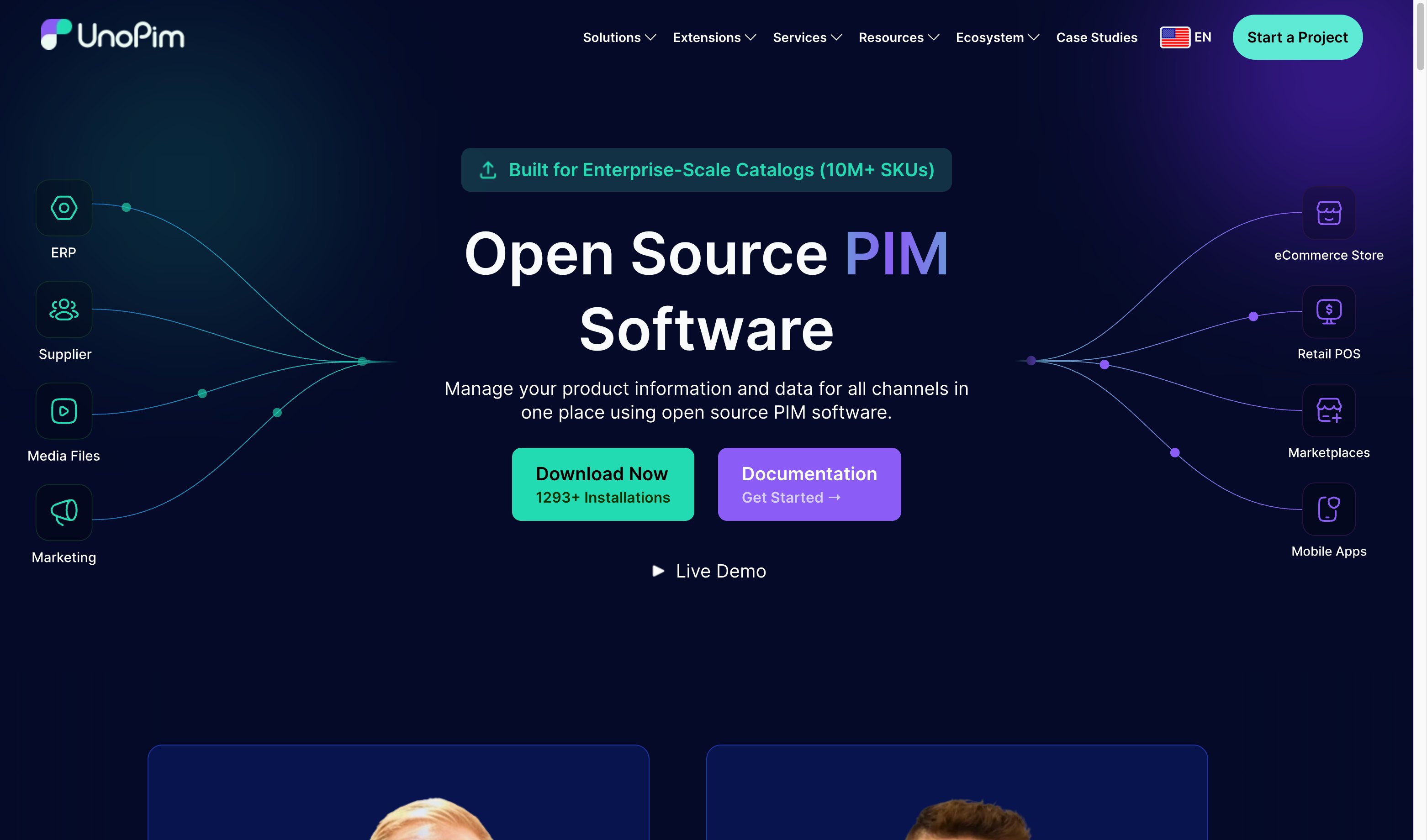
UnoPIM is a Laravel-based, fully open-source PIM built by Webkul. It targets Magento merchants who want a dedicated PIM without enterprise licensing costs. The native Magento 2 connector (available via Webkul for ~$199) supports products, categories, attributes, and media for both simple and configurable product types.
Why UnoPIM in 2026: With Akeneo CE receiving no new features, UnoPIM fills the gap as the strongest open-source PIM option with active Magento focus. It is a top alternative for cost-conscious merchants and open-source advocates.
Strengths:
- Fully open source (MIT License)
- Native Magento 2 connector via Webkul ($199 one-time)
- Supports simple and configurable products, categories, attributes, media
- Laravel-based, familiar stack for PHP developers
- Active development and growing community
Limitations:
- Smaller ecosystem than Akeneo or Pimcore
- No built-in DAM (media management is basic)
- Best suited for small to mid-size catalogs
- Fewer enterprise workflow features than paid alternatives
4. Bluestone PIM
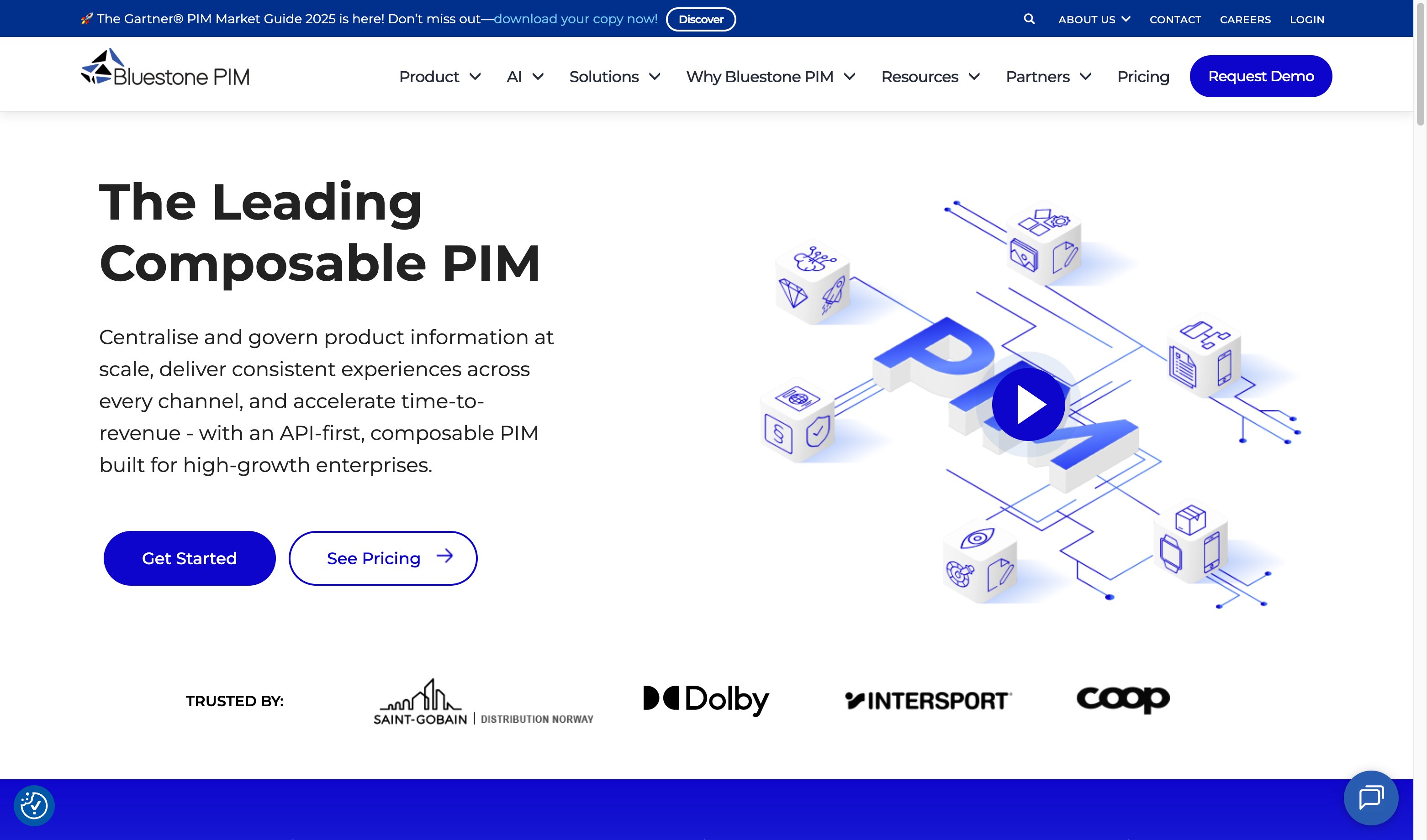
Bluestone PIM is a cloud-native, MACH-certified SaaS platform built for B2B and omnichannel commerce. It received its first external investment (Scale Leap Capital and Narwhal Investments) in January 2024, signaling continued growth and independence.
Strengths:
- Cloud-based, MACH-certified architecture
- Native Magento 2 connector
- Strong data validation and consistency tools
- Built for B2B commerce workflows
Limitations:
- No open-source option
- Pricing is quote-based
- Smaller partner ecosystem than Akeneo or Pimcore
5. inRiver PIM
inRiver is an enterprise-grade SaaS PIM recognized as a Leader in the 2024-2025 IDC MarketScape for Product Information Management. It offers three packages: Core, Professional, and Enterprise.
Strengths:
- IDC MarketScape Leader 2024-2025
- Advanced analytics and reporting
- Multi-language, multi-currency, and regulatory compliance support
- Strong partner ecosystem with certified Magento integrators
Limitations:
- Enterprise-focused pricing (not ideal for small merchants)
- No open-source option
- Connector setup requires a certified implementation partner
Honorable Mentions
Sales Layer: Known for the fastest onboarding in the PIM space (around 6 weeks on average). SaaS-based with a Magento connector. Strong choice for merchants who need quick time-to-value.
AtroPIM: Open-source PIM with a native Magento integration module. Flexible and extensible, suited for merchants who want full control over their PIM stack.
How to Select the Right PIM for Magento 2
Choosing the wrong PIM wastes months of integration work and budget. Focus on these five criteria.
1. Catalog complexity. Stores with 500 to 5,000 SKUs and simple attributes can start with UnoPIM or Akeneo Growth. Stores with 10,000+ SKUs, complex relationships, and multi-language needs should evaluate Pimcore or inRiver.
2. Connector availability. Akeneo has a free, maintained Magento connector. Bluestone PIM and UnoPIM offer native connectors. Pimcore and inRiver require API-based or partner-built connectors. As of March 2026, current security patches for 2.4.8 are recommended. Confirm connector compatibility with your exact Magento version.
3. Open source vs SaaS. Open-source (Pimcore, UnoPIM, Akeneo CE) gives full control but demands development resources. SaaS (Bluestone, inRiver, Akeneo Growth) reduces maintenance overhead at a higher monthly cost.
4. Budget. Open-source PIM tools are free to use, but implementation, hosting, and maintenance add up. SaaS options bundle infrastructure costs into the subscription. Always request quotes since no enterprise PIM publishes fixed pricing.
5. Integration method. Three approaches exist:
| Method | Speed | Flexibility | Best For |
|---|---|---|---|
| Extension/Connector | Fast (days) | Limited to connector features | Standard setups |
| API integration | Medium (weeks) | High, full data control | Custom workflows |
| Middleware (iPaaS) | Medium (weeks) | Very high, connects multiple systems | Complex multi-system landscapes |
Hosting Requirements for Magento PIM Integration
PIM connectors sync large volumes of product data through Magento API. This puts specific demands on your hosting infrastructure.
PHP version. Magento 2.4.8 (released April 2025) supports PHP 8.2, 8.3, and 8.4. PHP 8.1 is no longer supported. Confirm your hosting runs a compatible PHP version before installing any PIM connector.
Memory and processing power. Bulk product imports through a PIM connector consume more memory than standard admin operations. Stores syncing 5,000+ products need at least 4 GB RAM allocated to PHP. High-volume catalogs may require 8 GB or more. Check the Magento system requirements for baseline specifications.
API rate handling. PIM connectors make hundreds or thousands of API calls during sync. Your hosting must handle concurrent API requests without timeouts or 503 errors. Managed Magento hosting providers configure PHP workers, database connections, and caching layers to handle this load.
Cron job reliability. Most PIM connectors use Magento cron jobs for scheduled syncs. Unreliable cron execution causes data gaps between PIM and storefront. Managed hosting ensures cron jobs run on time with proper resource allocation.
Uptime during imports. Product imports should not slow down the storefront for shoppers. A hosting setup with proper Magento performance tuning separates import processing from frontend serving.
How Long Does Magento PIM Integration Take?
Integration timelines depend on the PIM system, catalog size, connector type, and data complexity. Different PIM platforms have very different setup requirements.
Timeline by PIM System
| PIM System | Typical Timeline | Why |
|---|---|---|
| UnoPIM | 4 to 8 weeks | Native Magento connector, simple setup |
| Sales Layer | 4 to 8 weeks | Fastest onboarding (~6 weeks average) |
| Akeneo Growth | 6 to 12 weeks | SaaS setup, data mapping, connector configuration |
| Bluestone PIM | 8 to 16 weeks | Partner-assisted setup, B2B data modeling |
| inRiver | 8 to 16 weeks | Partner-assisted, enterprise data complexity |
| Pimcore | 3 to 9 months | Development-heavy, custom connector, PIM+DAM+CMS setup |
Standard Integration Phases
| Phase | Duration | Activities |
|---|---|---|
| Planning | 1 to 2 weeks | Data mapping, attribute alignment, connector selection |
| Implementation | 1 to 4 weeks | Connector installation, field mapping, API configuration |
| Testing | 2 to 4 weeks | Data validation, sync testing, edge case handling |
| Go-live | 1 week | Final sync, monitoring, performance verification |
Cost factors: Connector licensing (free to $10,000+/year), implementation services ($5,000 to $30,000 depending on complexity), and ongoing maintenance. Open-source connectors reduce licensing costs but may increase implementation effort.
Common Magento PIM Integration Mistakes
These five mistakes cause the most delays and data issues during PIM integration.
1. Skipping data structure planning. Mapping product attributes between PIM and Magento before implementation prevents field mismatches and data loss during sync. Define your product attribute structure first.
2. Integrating everything at once. Start with core product data (names, descriptions, prices, images). Add complex data types (configurable products, bundles, related products) in a second phase. Phased rollouts catch errors early.
3. Ignoring digital asset workflows. Product images and documents need clear ownership rules. Decide whether the PIM or Magento is the master source for media files before you start syncing.
4. Choosing PIM by popularity instead of fit. Akeneo leads in market recognition, but a B2B manufacturer with 50,000 SKUs and complex relationships may need Pimcore or inRiver. Match the PIM to your catalog structure, not to review scores.
5. Underestimating hosting requirements. A PIM connector that works on a development server may fail on production under real data volumes. Test imports with your full catalog on production-grade hosting before go-live.
Who Benefits Most from Magento PIM Integration?
Not every Magento store needs a PIM. Here is who gets the most value.
Multi-channel sellers. Merchants selling on their Magento store plus Amazon, eBay, and wholesale portals. A PIM ensures product data stays consistent across all channels.
B2B manufacturers. Companies with complex product relationships, configurable items, and technical specifications. PIM handles the data complexity that Magento native catalog struggles with at scale.
International retailers. Stores operating in multiple languages and currencies. PIM systems handle translation workflows and regional pricing from one central platform.
Fast-growing catalogs. Merchants adding 100+ products per month. PIM scales catalog management without proportional increases in manual work.
Stores with 500+ SKUs. Below this threshold, Magento native product management handles the workload. Above it, spreadsheet workflows become error-prone and slow.
Pros and Cons of Magento PIM Integration
| Pros | Cons |
|---|---|
| One source of truth for all product data | Adds a separate system to maintain |
| Up to 6x faster product data management vs Excel | Implementation takes 4 to 16 weeks depending on PIM |
| Consistent data across all sales channels | Requires dedicated catalog manager role |
| Reduces manual errors and duplicate entries | Enterprise PIM pricing is quote-based |
| Supports multi-language and multi-currency | Open-source connectors need developer support |
Conclusion
A PIM system turns chaotic product data into a structured, single source of truth for your Magento store. The right PIM depends on your catalog size, channel complexity, and technical resources.
For most mid-market Magento merchants, Akeneo Growth or UnoPIM offers the best balance of features and cost. Enterprise operations with 10,000+ SKUs and complex compliance needs should evaluate inRiver or Bluestone PIM. Pimcore suits teams that want PIM, DAM, and CMS in one platform and have development capacity.
Before integration, verify your hosting can handle the additional API load. Managed Magento hosting with proper PHP configuration, memory allocation, and cron reliability is the infrastructure foundation that makes PIM connectors run smooth.
Contact us for a PIM-readiness check of your hosting environment, or request a free demo of managed Magento hosting on AWS.
FAQ
1. What is a PIM system and how does it work with Magento?
A PIM (Product Information Management) system centralizes all product data in one platform. It connects to Magento through a connector or API, syncing product names, descriptions, attributes, images, and prices to your store. Changes in the PIM update Magento without manual re-entry.
2. What are the best PIM systems for Magento 2 in 2026?
The top five PIM systems for Magento 2 are Akeneo, Pimcore, UnoPIM, Bluestone PIM, and inRiver. Akeneo, Pimcore, and UnoPIM offer open-source options. Bluestone and inRiver are SaaS platforms with native or partner-built Magento connectors. Sales Layer and AtroPIM are strong alternatives.
3. How long does Magento PIM integration take?
Timelines vary by PIM system. UnoPIM and Sales Layer take 4 to 8 weeks with native connectors. Akeneo Growth takes 6 to 12 weeks. Bluestone and inRiver take 8 to 16 weeks with partner-assisted setup. Pimcore takes 3 to 9 months due to its development-heavy custom approach.
4. What is the difference between Akeneo Community Edition and Growth?
Akeneo Community Edition is open-source and self-hosted. The official Magento connector is still maintained (last release December 2025), but CE has received no new major features since 2023. Akeneo Growth is a SaaS edition with active development, AI features (GenAI content generation, PX Insights), and vendor support. New projects should start with Growth.
5. Do I need a connector to integrate PIM with Magento?
Yes, in most cases. Connectors provide pre-built field mappings and sync logic between the PIM and Magento. Akeneo offers a free community connector. UnoPIM has a native connector via Webkul. Some merchants build custom API integrations instead, which offers more flexibility but requires development resources.
6. How much does Magento PIM integration cost?
Costs depend on the PIM platform, connector type, and implementation complexity. Open-source PIM tools (Pimcore, UnoPIM, Akeneo CE) are free to license. UnoPIM's Magento connector costs ~$199 one-time. Implementation services range from $5,000 to $30,000. SaaS PIM subscriptions are quote-based. Budget for hosting upgrades if your current infrastructure cannot handle bulk API imports.
7. What is the difference between PIM and ERP for Magento?
A PIM manages product content (descriptions, images, attributes, translations). An ERP manages business operations (orders, invoices, inventory, accounting). Most Magento stores need both: the ERP for order processing and the PIM for catalog management. They serve different purposes and complement each other.
8. What hosting do I need for Magento PIM integration?
PIM connectors require Magento hosting with PHP 8.2 or higher, at least 4 GB RAM for PHP processes, reliable cron job execution, and the ability to handle concurrent API requests. Managed Magento hosting providers pre-configure these settings. Stores syncing large catalogs (5,000+ SKUs) should test import performance on their production hosting before go-live.
9. Can I integrate multiple PIM systems with one Magento store?
This is rare and not recommended. Running two PIM systems creates data conflicts and sync complexity. Choose one PIM as the master source. If different departments use different tools, designate one PIM as the Magento connector and use API feeds between the PIM systems.
10. What are the benefits of Magento PIM integration for SEO?
PIM systems improve SEO by ensuring consistent, complete product data across all pages. Rich product descriptions, proper attribute values, and structured data reduce thin content issues. Faster catalog updates mean new products get indexed sooner. Consistent product naming across channels strengthens brand signals.