Shopware vs Magento 2: Choosing the Right Ecommerce Platform in 2026
[Updated: April 14, 2026]
Shopware and Magento are the two leading open source commerce platforms for ambitious merchants. This 2026 comparison covers the latest Shopware 6.7.8 and Magento 2.4.8-p4 releases across pricing, hosting requirements, B2B capabilities, and real total cost of ownership. Whether you are evaluating a new platform or planning a migration, this guide helps you pick the right fit for your team and business model.
Key Takeaways
- Shopware Community Edition is free; Shopware Rise starts at €600/month, Evolve at €2,400/month, and Beyond is quote based.
- Magento Open Source is free; Adobe Commerce pricing is quote based and typically lands in the €20,000 to €180,000 per year range for enterprise contracts.
- Shopware ships with a modern PHP 8.2 plus Symfony 7 stack and the latest v6.7.8.2 release from March 2026.
- Magento 2.4.8-p4 (March 2026) runs on PHP 8.3 or 8.4, MariaDB 11.4, and OpenSearch 3 or Elasticsearch 8.
- Magento wins on ecosystem scale, deep developer community, and B2B depth.
- Shopware wins on developer experience, the App System with upgrade safe sandboxing, and user friendly admin for non technical teams.
- Pick Magento for enterprise B2B, global multi store setups, and heavy customization. Pick Shopware for mid market D2C brands, storytelling driven commerce, and faster upgrade cycles.
Quick Verdict: Shopware vs Magento at a Glance
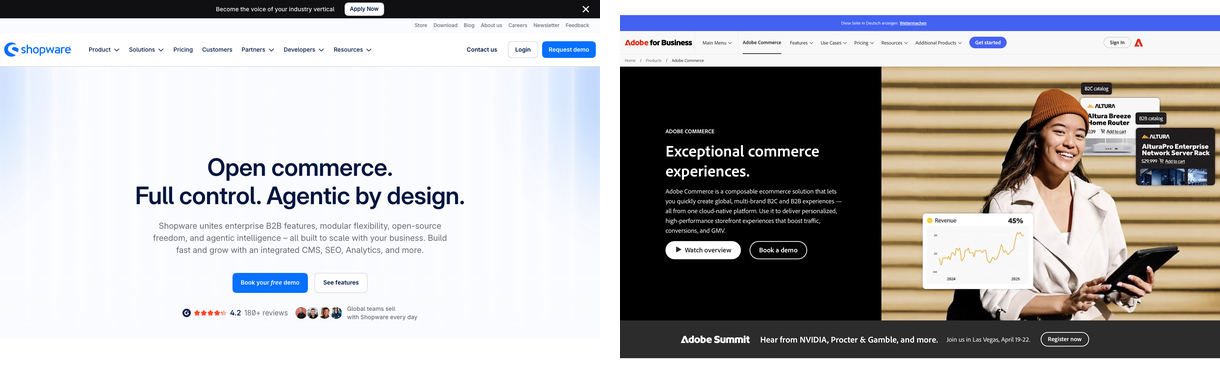
Both vendors lead with a different message on their homepages. Shopware positions itself around modern open commerce and developer experience, while Adobe Commerce leads with composable enterprise commerce and the broader Adobe ecosystem.
| Criterion | Shopware 6 | Magento 2 / Adobe Commerce |
|---|---|---|
| Latest version (April 2026) | v6.7.8.2 (Mar 18, 2026) | 2.4.8-p4 (Mar 10, 2026) |
| Founded | 2000 (Schöppingen, Germany) | 2007 (Culver City, USA) |
| License model | Free Community + Rise/Evolve/Beyond tiers | Free Open Source + Adobe Commerce quote |
| Core stack | PHP 8.2+, Symfony, Vue.js, MariaDB | PHP 8.3/8.4, Laminas, MariaDB 11.4, OpenSearch 3 |
| Ecosystem | Thousands of extensions, strong DACH+EU community | Thousands of extensions, largest open source commerce community |
| B2B depth | Strong (B2B Components since 2023) | Industry leading |
| Best fit | D2C brands, storytelling, mid market | Enterprise B2B, multi store, complex catalogs |
| Hosting complexity | Moderate | High (needs tuned infrastructure) |
Pricing and Total Cost of Ownership
License fees tell only part of the story. Real TCO includes hosting, extensions, development, and maintenance. The 2026 pricing picture for both platforms looks different from older comparison articles.
Shopware 2026 Pricing
Shopware publishes transparent tier pricing on shopware.com:
| Edition | Monthly list price | Ideal for |
|---|---|---|
| Community | Free (open source) | Developers, small shops, evaluation |
| Rise | from €600/month | Growing D2C brands, SaaS like convenience |
| Evolve | from €2,400/month | Mid market with 24/7 support needs |
| Beyond | Custom quote | Enterprise with 1 hour SLA response |
Magento 2026 Pricing
Magento splits into two products:
- Magento Open Source: Completely free. You pay only for hosting, extensions, and development.
- Adobe Commerce: Quote based. Contracts typically land in the €20,000 to €80,000 per year range for mid market and €80,000 to €180,000+ per year for enterprise, based on gross merchandise value tiers. Adobe does not publish list prices.
Real TCO Breakdown (annual, EU mid market store)
| Cost category | Shopware Rise setup | Magento Open Source setup | Adobe Commerce setup |
|---|---|---|---|
| License | €7,200 | €0 | €30,000 to €80,000 |
| Managed hosting | €3,000 to €18,000 | €6,000 to €60,000 | Included (Cloud) |
| Extensions | €2,000 to €5,000 | €3,000 to €8,000 | €3,000 to €8,000 |
| Development (annual avg) | €10,000 to €25,000 | €15,000 to €40,000 | €15,000 to €40,000 |
| Typical total | €22,000 to €55,000 | €24,000 to €108,000 | €48,000 to €150,000+ |
Magento Open Source can be the most affordable for teams with in house development skills. Adobe Commerce is the most expensive but includes cloud hosting and Adobe Experience Cloud integration. Shopware sits in the middle with predictable subscription costs.
Hosting Requirements and Server Costs
This is where the two platforms diverge the most, and where most comparison articles skim. Getting hosting right is the single biggest factor in real world performance for either platform.
Shopware 6 Hosting Requirements (v6.7.x)
| Component | Requirement |
|---|---|
| Operating System | Linux (Debian/Ubuntu/RHEL) |
| Web server | Nginx 1.24+ or Apache 2.4+ |
| PHP | 8.2, 8.3, 8.4, or 8.5 |
| Database | MariaDB 10.11+ / MySQL 8.0+ |
| RAM (minimum) | 4 GB |
| Search | Built in (OpenSearch optional for high traffic) |
| Architecture | Composer based, Symfony 7 |
Magento 2.4.8 Hosting Requirements
| Component | Requirement |
|---|---|
| Operating System | Linux x86_64 |
| Web server | Nginx 1.24+ or Apache 2.4+ |
| PHP | 8.3 or 8.4 |
| Database | MariaDB 11.4 |
| Search engine | OpenSearch 3 (Adobe Commerce Cloud) or Elasticsearch 8 (on premises) |
| Cache | Redis 7.2 for sessions and cache |
| Message queue | RabbitMQ 3.13 |
| RAM (minimum) | 4 GB for backend, 8+ GB recommended |
Magento demands more infrastructure pieces working together. A real production Magento setup needs Redis, a dedicated search engine, a message queue, and a properly tuned MariaDB. Shopware ships with fewer moving parts by default.
For both platforms, specialized managed hosting outperforms generic shared or VPS hosting. Our Magento hosting platform is built specifically around the Magento 2 stack with auto scaling, preconfigured Redis, OpenSearch, and RabbitMQ. Check the Magento system requirements guide for a deeper dive on what production Magento actually needs.
Features and Customization
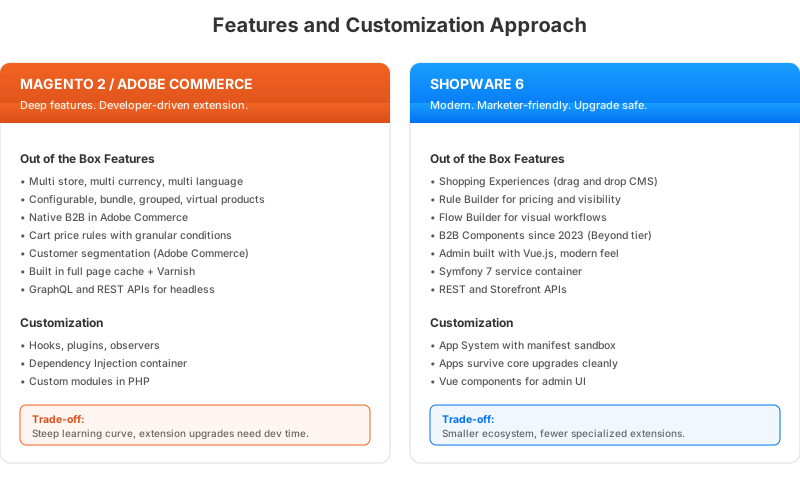
Both platforms are open source at their core. The difference shows in how you extend them.
Magento Feature Depth
Magento has the deeper feature set out of the box:
- Native multi store, multi website, multi currency, multi language
- Advanced catalog with configurable, bundle, grouped, virtual, and downloadable product types
- Native B2B features in Adobe Commerce: company accounts, shared catalogs, quote workflow, purchase orders
- Rule based promotions and cart price rules with granular conditions
- Customer segmentation and targeted content (Adobe Commerce)
- Built in full page cache and Varnish integration
- GraphQL and REST APIs for headless commerce
The downside: Magento customization needs developer time. The platform gives you hooks and plugins but expects you to know Magento conventions.
Shopware Flexibility
Shopware takes a more approachable path:
- Shopping Experiences: drag and drop CMS blocks for landing pages and product detail pages
- Rule Builder: create complex conditions for pricing, shipping, and product visibility without code
- Flow Builder: visual workflow automation for notifications, CRM syncs, and order events
- App System: third party apps run in a sandbox with an app manifest, which survives core upgrades without breaking
- Admin Components: customize the admin UI with Vue.js components
Shopware's App System is a concrete win for upgrade safety. A Magento merchant facing a major version upgrade often deals with incompatible extensions that need developer intervention. Shopware apps designed against the manifest API typically survive upgrades cleanly.
For custom themes, both platforms offer extensive options. See our Magento themes guide for Magento specific design guidance.
Usability and Admin Experience
The admin interface is where daily store operations happen, so this matters more than feature count for most teams.
Shopware's admin is built with Vue.js and feels like a modern SaaS tool. Non technical store managers can edit products, create landing pages with Shopping Experiences, build automation flows, and manage orders without touching code. The learning curve for basic operations is measured in hours.
Magento's admin is more powerful but more complex. Every piece of functionality has settings, and settings often interact. Experienced Magento admins work fast, but new users face a learning curve measured in weeks. Adobe Commerce adds the Admin Page Builder which helps, but the underlying complexity remains.
Concrete Example: Creating a Promotional Campaign
In Shopware, a marketing manager opens the Rule Builder, drags conditions (Customer Group equals "VIP", Cart Value greater than €500), attaches a 15% discount action, and activates the rule. Total time for a trained user: under five minutes, zero code.
In Magento, the same workflow runs through Cart Price Rules. You configure the rule scope, customer segment, conditions with nested logic groups, action type, and discount calculation. It works, but the form spans multiple tabs and each field has interaction effects. Total time for a trained user: 15 to 20 minutes, still zero code, but more cognitive load.
For teams without dedicated Magento expertise, Shopware's admin is friendlier. For large operations with trained merchandisers, Magento's depth pays off.
B2B Capabilities
B2B commerce is where Magento still leads, and where Shopware has been closing the gap.
Magento B2B (Adobe Commerce)
Adobe Commerce ships with B2B features that most platforms treat as paid extensions:
- Company accounts with hierarchical user roles
- Shared catalogs with company specific pricing
- Quote request and negotiation workflow
- Purchase orders with approval rules
- Requisition lists and quick order forms
- Credit limit management
Our Magento B2B features breakdown covers the full B2B toolkit.
Shopware B2B Suite
Shopware rolled out B2B Components starting in 2023 as part of the Beyond tier:
- Employee management with role based access
- Individual pricing and discounts per customer
- Quote workflow
- Order approval processes
- Integration with ERP systems through the App System
Shopware B2B is solid but newer and less battle tested than Magento's. For complex B2B with multiple divisions, contract pricing, and approval chains, Magento remains the safer bet.
Performance and Scalability
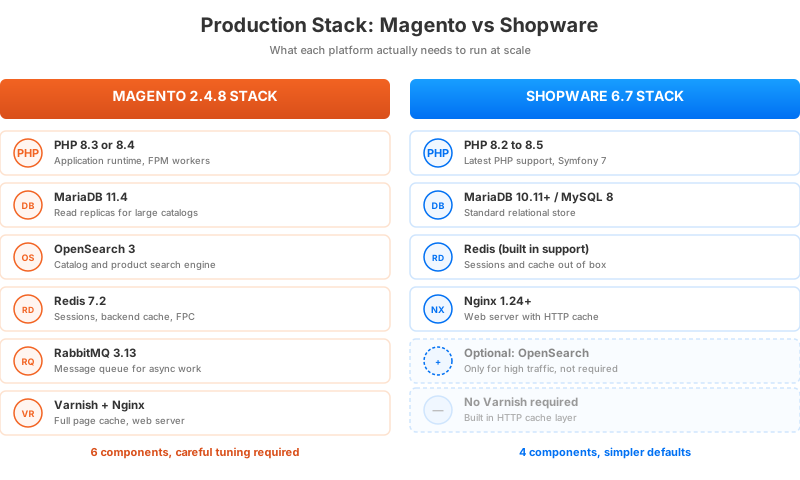
At the server level, both platforms can scale to handle large catalogs and peak traffic. The path to get there differs.
Magento Performance Profile
Magento needs careful tuning:
- Full page cache (Varnish or built in)
- Redis for sessions and backend cache
- OpenSearch for catalog search
- Database read replicas for large catalogs
- Pre generated static assets
- Queue consumers for asynchronous work
With the right stack, a Magento store handles tens of thousands of SKUs and thousands of concurrent users. Without it, the same store slows to a crawl during sales events. Read our Magento 2 performance tuning guide for the full technology stack we recommend.
Shopware Performance Profile
Shopware's younger codebase runs well on equivalent hardware without as much tuning. Symfony's service container and the clean separation between storefront and admin reduce overhead. Shopware ships with HTTP cache and Redis integration out of the box.
For merchants with a technical team, Magento can be tuned to outperform Shopware on large catalogs. For merchants without deep server expertise, Shopware gives better default performance.
Ecosystem, Extensions, and Community
Community size shapes how you solve problems, hire talent, and find extensions.
Magento's community is one of the largest in open source commerce:
- A certified developer pool that spans agencies and freelancers across every continent
- A formal solution partner network through Adobe Commerce
- Thousands of extensions in the Magento Marketplace covering payments, shipping, B2B, marketing, and analytics
- Magento DevDocs, Adobe Experience League, Stack Exchange, and a large Reddit community
- Annual Adobe Summit and MageConf events
Shopware's community is smaller but active:
- Strong roots in DACH (Germany, Austria, Switzerland) with growing global presence
- Thousands of extensions in the Shopware Store
- Curated store with a quality focus
- Shopware Community Day events
- Active Slack and Discord communities
For finding talent or getting quick help with edge cases, Magento has the deeper pool. For a quality focused extension marketplace with less noise, Shopware is easier to navigate.
SEO and Marketing Tools
Both platforms handle the basics well. The question is how much you need out of the box versus how much you are willing to add with extensions.
Magento SEO
Magento includes comprehensive SEO controls:
- URL rewrites and canonical tags
- Automatic XML sitemap generation
- Robots.txt editor
- Meta tags and structured data
- Rich snippets for products
- Rel canonical for configurable products
Magento also integrates with Google Analytics 4, Google Tag Manager, and Adobe Analytics (in Adobe Commerce). Our Magento SEO guide covers the full optimization checklist.
Shopware SEO
Shopware matches Magento on fundamentals and adds a few conveniences:
- Custom URL structures per sales channel
- Automatic sitemap generation
- Structured data for products
- Open Graph and Twitter Card support
- Paid SEO Professional plugin (€249) adds bulk meta management
Both platforms produce SEO friendly output. Real world ranking depends more on hosting performance, Core Web Vitals, and content quality than on platform choice.
Which Platform Should You Choose?
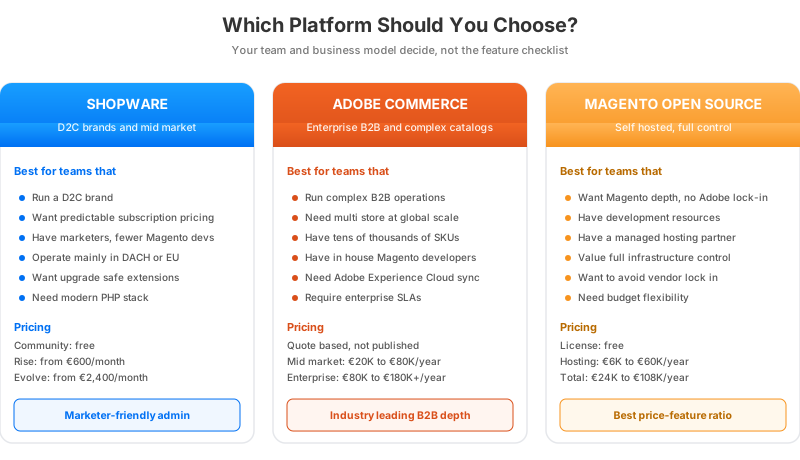
Skip the feature checklist. The decision usually comes down to your team and business model.
Choose Shopware if
- You run a D2C brand where storytelling and visual merchandising matter
- Your team includes marketers and merchandisers but few Magento developers
- You want predictable subscription pricing
- You operate mainly in DACH or the EU
- You want modern PHP stack without legacy Zend code
- Upgrade safety is critical and you want extensions that survive core upgrades
Choose Magento or Adobe Commerce if
- You run a complex B2B operation with contract pricing and approval workflows
- You need multi store, multi currency, multi language at scale
- Your catalog has tens of thousands of SKUs with custom attributes
- You have in house Magento developers or a committed agency partner
- You need deep Adobe Experience Cloud integration (marketing automation, analytics, CDP)
- Enterprise SLAs and compliance frameworks matter
Choose Magento Open Source (self hosted) if
- You want the feature depth of Magento without Adobe's enterprise licensing
- You have development resources or a managed hosting partner
- You value full control over infrastructure
- You want to avoid vendor lock in
FAQ
What is the biggest difference between Shopware and Magento in 2026? Shopware leads on developer experience, upgrade safety, and admin usability. Magento leads on enterprise B2B depth, ecosystem scale, and deep customization. Shopware appeals to mid market D2C brands. Magento appeals to enterprise and complex catalogs.
Is Shopware or Magento better for SEO? Both platforms produce SEO friendly output. Magento has more built in SEO controls, and Shopware catches up with extensions. Real world SEO performance depends more on hosting speed, Core Web Vitals, and content strategy than on platform choice.
Which platform is cheaper to run? Magento Open Source can be the cheapest if you have development skills and an affordable managed hosting partner. Shopware Rise offers predictable subscription pricing at €600 per month plus hosting. Adobe Commerce sits at the top end with enterprise licensing that starts around €20,000 per year plus infrastructure.
Can I migrate from Magento to Shopware, or vice versa? Yes, both directions are possible. Migration tools like LitExtension automate product, customer, and order migration. Custom fields, URL rewrites, and extension logic usually need manual rework. Plan for two to four weeks for a mid size catalog migration. Teams upgrading from Magento 1 should read our Magento 1 vs Magento 2 migration guide first before evaluating a platform switch.
Is Adobe Commerce Cloud the same as Magento Commerce Cloud? Yes, Adobe rebranded Magento Commerce Cloud to Adobe Commerce Cloud after acquiring Magento in 2018. The underlying platform is the same, now more tightly integrated with Adobe Experience Cloud products (Adobe Analytics, Adobe Target, Adobe Experience Manager). See our Adobe Commerce Cloud guide for feature details.
Which platform has better hosting options? Magento demands a more specific stack: PHP 8.3 or 8.4, MariaDB 11.4, OpenSearch 3 or Elasticsearch 8, Redis 7.2, and RabbitMQ 3.13. This is why dedicated managed Magento hosting exists. Shopware runs on simpler infrastructure and works well on general PHP hosting if the hardware is sufficient.
Summary
Shopware and Magento are the two strongest open source commerce platforms in 2026. They occupy different positions in the market.
Shopware 6.7 is the modern choice: PHP 8.2+ stack, Symfony 7, the App System for upgrade safety, and a friendly admin. It fits D2C brands, mid market operations, and teams that want predictable costs.
Magento 2.4.8 remains the enterprise standard: the deepest B2B toolkit, the largest developer community, and the richest ecosystem. It fits complex catalogs, multi store operations, and teams with dedicated Magento expertise.
The right choice depends less on features and more on your team, your business model, and your hosting partner. For Magento operations at any serious scale, the hosting stack matters as much as the platform itself. Our Magento hosting platform is purpose built around Magento 2 with everything production needs: Redis, OpenSearch, RabbitMQ, and auto scaling on AWS.
Whichever platform you choose, invest in the stack that runs it.